

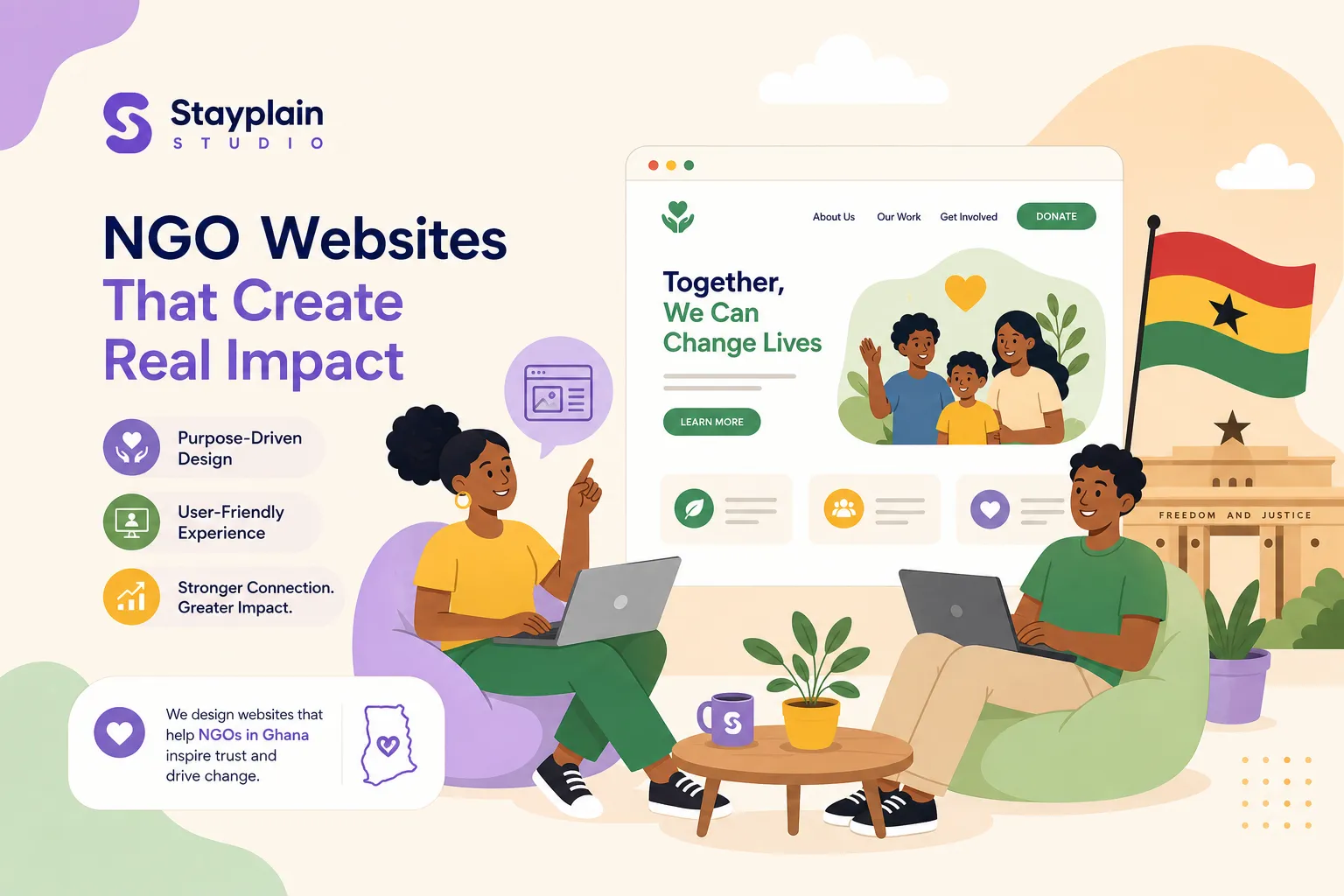

If you're searching for an NGO website design company in Ghana, this guide will show you what features to demand, what budget to plan, and which red flags to walk away from. You've watched donors land on your NGO's website and leave without giving a penny. The problem usually isn't your mission. It's the website.
Quick Answer: An NGO website design company in Ghana should offer proven experience with non-profit sites, donation gateway integration (Paystack, mobile money), storytelling-led design, accessible and mobile-first builds, and transparent post-launch support such as Stayplain Studio. The agency should understand that your website's job is to convert visitors into donors and grant funders, not merely to display your logo.
Many NGO websites in Ghana are built to look credible rather than to actually perform. They have a nice header image, a mission statement, and a contact page, and then they sit there doing nothing. No donation flow. No impact storytelling. No clear path for a visitor to take action. Israel Acheampong, Founder and CEO of Stayplain Studio, has observed this pattern repeatedly across the non-profit sector. At Stayplain Studio, we have built NGO websites for Limitless Hope Foundation, SHEEPLBG, and Debcee J Foundation from the ground up, you can review these projects directly in our NGO website portfolio, each one engineered to move visitors from curiosity to contribution.
This guide is written for NGO leaders, communications managers, and programme officers who need to shortlist the right web design agency with confidence. By the time you finish reading, you will know what features to demand, what questions to ask, what budget to plan, and which red flags to walk away from.
Why most NGO websites in Ghana fail to convert visitors into supporters
The difference between a beautiful website and a functional one
The most common trap NGO leaders fall into is hiring an agency that delivers a visually polished site with no donation flow, no impact storytelling, and no clear call to action. Picture this: a donor lands on your homepage, reads your tagline, and sees no donation button above the fold. Within 30 seconds, they leave. Not because they don't care about your cause, but because your website didn't give them a reason to stay or an easy way to act.
A well-engineered NGO site does the opposite. It guides a visitor from curiosity to contribution with minimal clicks. The donation button is visible without scrolling. The impact story is on the homepage, not buried on an "About" page. The emotional connection comes first. The administrative detail comes later.
What "built to convert" means for a non-profit
Conversion for an NGO means donations, volunteer sign-ups, grant inquiry submissions, and newsletter subscriptions. These are not the same thing as page views or social media follows. Conversion-focused design is a different discipline from aesthetic design, and it is one that many generalist web agencies in Ghana do not practise. They build sites that look good in a browser. They do not build sites that systematically move people to act.
At Stayplain Studio, our philosophy is straightforward: every website we build is engineered for a specific outcome. For NGOs, that outcome is always measured in supporters gained, not pages viewed.
Why your website reflects your organisation's credibility
Donors, grant-makers, and corporate partners judge your organisation by your digital presence before they ever speak to your team. An outdated, slow, or disorganised site signals a disorganised organisation, regardless of the real impact you are creating on the ground. This is not fair, but it is the reality of how trust is built online.
Our work with organisations like Limitless Hope Foundation and Debcee J Foundation started with the same brief: build a site that demonstrates the seriousness of the work. Review the results in our NGO website portfolio in Ghana to see what a conversion-focused non-profit site looks like in practice.
How an NGO website design company in Ghana should handle donation pages
Payment gateways that actually work for Ghanaian donors
Choosing the wrong payment gateway is one of the most expensive mistakes an NGO can make. The gateways most commonly used for Ghana-based NGO websites are Paystack, Flutterwave, Hubtel, expressPay, and iPay Ghana. Each supports the major mobile money networks: MTN MoMo, Telecel Cash, and AirtelTigo Money.
| Gateway | Best use case | Integration method |
|---|---|---|
| Paystack | Local and Africa-wide donations; best for donation page/payment links | Hosted checkout, API, CMS plugins |
| Flutterwave | Multi-country African fundraising campaigns | Checkout page, API, CMS plugins |
| Hubtel | Ghana-focused collections with strong mobile money support | Developer/API setup or direct integration |
| expressPay | Card and mobile money in one form | Hosted checkout, API |
| Stripe / PayPal | International donors paying by card | Plugin, hosted checkout, API |
The right agency for your NGO will already know which gateway fits your donor base before they write a single line of code. They will not simply install whatever is easiest for them to set up.
What a high-converting donation form looks like
A donation form that converts has short fields, a single-page checkout, suggested donation amounts (GHS 20, GHS 50, GHS 100), and a brief "why I'm giving" prompt that keeps the emotional connection alive at the moment of transaction. It also offers a recurring giving option, because monthly donors typically provide more predictable revenue over time than one-off contributors. Trust signals matter too: an SSL badge, your registration number, and a one-line impact statement placed directly beside the submit button all reduce drop-off. Post-donation features such as a donor dashboard for managing receipts and recurring gifts also improve long-term retention.
Mobile money: the non-negotiable for Ghana-based NGOs
Mobile money is how many small donors in Ghana give. If your donation page does not support MTN MoMo or Telecel Cash, you are losing real donors every week. This is not a feature request; it is a baseline requirement. When shortlisting any agency, ask them to show you a live example of mobile money integration on an NGO website they have already built and launched. If they cannot, keep looking.
Storytelling design that moves people to give
Structuring your impact section for maximum emotional pull
The "beneficiary-first" layout works. Lead with a face, a name, and a one-line story before you present any statistics. This is the opposite of what many NGOs in Ghana do. The common mistake is leading with the organisation's history and founding year, information donors do not need before they feel something. A good non-profit website design agency in Ghana will guide you on what content goes where, rather than designing around whatever you send them.
Project pages, photo stories, and field testimonials
Each active project deserves its own dedicated page with a narrative arc: the problem, the intervention, and the outcome. Photos of real beneficiaries, taken with proper consent, outperform stock images by a wide margin in trust-building. Donors want to see the real work, not a generic image of hands holding a seedling. Video testimonials embedded on project pages can increase donation page conversion significantly, particularly when they feature direct quotes from community members rather than scripted programme reports.
Campaign and annual report pages that keep funders engaged
NGOs with strong annual report pages have a lower-friction path to repeat donors and returning grant funders. A well-structured impact report page is not a PDF download link. It is a dedicated, visual, scroll-friendly page that presents key outcomes, financial summaries, and stories in a format that works on both mobile and desktop. The difference between a web agency that "uploads documents" and one that designs for engagement is the difference between a funder who skims and a funder who commits.
Grant credibility: what funders quietly check on your website before approving anything
The pages grant-makers look for first
International grant-makers follow a predictable due-diligence checklist when they visit your website. They are looking for your legal registration and compliance details, leadership and board profiles with professional photographs and brief bios, a financials or stewardship section with annual reports and audited accounts, and a dedicated "Partner with Us" or funder information page. Missing even one of these signals that your organisation may not be ready to manage institutional funds responsibly.
- Registration and legal compliance details (NGO registration number, tax exemption status)
- Leadership and board profiles with current photographs
- Annual reports, audited accounts, and donor disclosures
- A dedicated funder or partner information page
- Programme descriptions with clear goals, timelines, and expected outcomes
How your website design communicates organisational maturity
A grant-maker who visits your site and finds broken links, outdated news sections, or a copyright footer still reading "2022" draws conclusions about how you manage everything else. Design consistency, current content, and a clear information hierarchy all communicate operational health before a single conversation takes place. This is why design is never purely aesthetic for an NGO; it is a governance signal.
Expert Insight: "We have seen NGOs in Ghana lose grant opportunities not because their work was weak, but because their website could not demonstrate it. A funder who cannot find your registration details or your last annual report on your website will not ask you to email it. They will simply move on.", Israel Acheampong, Founder and CEO, Stayplain Studio.
Building a transparency page that works for international donors too
NGOs seeking funding from international or diaspora donors need to meet a higher standard of digital credibility. Your transparency page should include your organisational background, impact numbers, programme descriptions, governance structure, and contact details with a clear response commitment. If your key documents are only available in a local language, consider providing English summaries alongside them. International funders expect key information in English, particularly for formal due-diligence reviews.
Accessibility and mobile-first design for Ghana's donor audience
Why mobile-first design is not optional for Ghanaian NGOs
The majority of internet users in Ghana access the web via mobile devices, not desktops. A website that looks perfect on a 24-inch monitor but breaks on a GHS 500 Android phone is effectively invisible to most of your audience. When you are evaluating any shortlisted agency, ask them to open the NGO website they are most proud of on a mobile device in portrait mode. Watch what happens. The answer will tell you everything.
Basic accessibility your web designer must understand
WCAG 2.1 Level AA is the recommended baseline for non-profit websites, and WCAG 2.2 Level AA is the recommended upgrade path for a future-proof build. In practical terms, this means alt text on all images, keyboard-navigable menus, sufficient colour contrast ratios, clearly labelled form fields, and no CAPTCHA that blocks non-technical users. An accessible website also ranks better on Google, because the same signals that help screen readers help search engine crawlers.
Data-light design for low-bandwidth users
Many Ghanaians access websites on limited mobile data plans. A page that loads in eight seconds on a 4G connection loses users before they read a single word of your content. The design decisions that help are straightforward: compressed images, minimal third-party scripts, deferred loading, and a lightweight page structure. A competent NGO website design company in Ghana should target a Google PageSpeed Insights score of 80 or above for mobile, treat this as a performance goal to discuss with any agency before you sign anything, alongside real-world testing on local devices.
The technical backbone every NGO website in Ghana needs
CMS choice: why WordPress dominates for NGOs in Ghana
WordPress powers the majority of NGO websites in Ghana and globally because of its flexibility, its large plugin ecosystem (donation plugins, event management tools, form builders), and the availability of trained local developers who can maintain it. The key advantage for NGOs is that your communications team can update content, publish field updates, and manage campaigns without needing a developer every time. That operational independence matters, especially in organisations where technical budgets are tight.
One caution: a CMS is only as good as the team that builds on it. Bloated premium themes and unvetted plugins are the most common source of slow, insecure NGO sites in Ghana. Demand a clean, well-documented build from day one.
SSL, security, and backups for NGO donor data
Any website collecting donor information or processing payments must have an active SSL certificate (HTTPS). This is not negotiable. Automatic daily backups and malware scanning are also non-negotiable, not optional add-ons that you pay extra for later. Ask every agency you speak to: who manages security updates after launch, and what is the response time if the site is compromised? If they hesitate, that hesitation is your answer.
For NGOs running WordPress, proactive security management is critical. Our WordPress security service for NGO websites covers malware removal, hardening, and ongoing monitoring so your donor data stays protected at all times.
What to actually look for when evaluating an NGO website design company in Ghana
Portfolio proof: have they built for non-profits before?
The single fastest filter when shortlisting a web design agency is this: does the agency have documented non-profit work in their portfolio? Not "we work with all industries." Actual live examples. When you review their NGO portfolio, check whether the donation flow is functional, whether the site loads quickly on mobile, and whether impact stories are designed to engage or simply presented as plain text paragraphs.
Stayplain Studio's work with Limitless Hope Foundation, SHEEPLBG, and Debcee J Foundation provides a practical reference point for what a conversion-focused NGO site looks like. Each build started with a brief to solve a real problem: no website and low online visibility. The result in each case was an SEO-optimised site built to increase traffic and donor inquiries. Review the full documentation in our NGO website case studies.
Post-launch support and team training
Many NGO teams have limited technical capacity. The right agency will train your staff to manage content, update project pages, and publish field reports without needing a developer to intervene. Ask specifically: what does your post-launch handover process look like? Is there written documentation? Is there a live training session included? A charity website developer in Accra or Kumasi who disappears after launch is a direct risk to your organisation's digital continuity and donor relationships.
Red flags to watch for before you commit
Some warning signs are obvious. Others are easy to miss if you are not looking. Here is what should make you pause before signing any contract with a web design agency:
- No portfolio of live NGO or non-profit websites to review
- A quoted price that does not mention donation gateway integration, SSL, mobile optimisation, or CMS training
- No clear project timeline or milestone-based payment structure
- No local point of contact or defined support arrangement after the site goes live
- Vague answers when you ask about page speed performance or accessibility compliance
Choosing the best web design company in Ghana for NGOs comes down to finding a team that asks the right questions before they start designing, not one that simply presents a template and asks you to fill it in.
NGO website packages and pricing in Ghana: what to budget for in 2026
Basic, standard, and advanced NGO website packages
Based on current Ghana web design market rates, here is a realistic breakdown of what NGO website builds cost in 2026. These figures reflect the full scope of a properly built site, not a rushed template job, and represent agency-level pricing for sites engineered to perform rather than simply exist.
| Package | What is included | Estimated cost (GHS) |
|---|---|---|
| Basic | 5, 8 pages, contact form, mobile-responsive design, basic CMS setup | 2,000, 4,000 |
| Standard | 10, 15 pages, donation gateway integration, blog, volunteer form, basic SEO | 4,000, 8,000 |
| Advanced | Custom design, full donation system, impact report pages, event module, advanced SEO | 8,000, 15,000+ |
Hosting, domain registration, and ongoing maintenance are billed separately in most agency contracts. Factor these into your annual budget from the start. See our detailed breakdown of website design prices in Ghana for non-profits for a more granular view of what each line item typically costs.
Hidden costs most NGO budgets don't plan for
The headline design quote is rarely the total cost of ownership. Budget separately for each of the following:
- Annual domain renewal and hosting: approximately GHS 1000, 2,000 per year, depending on provider (see hosting table above for indicative ranges)
- Payment gateway setup and transaction fees: Paystack and Flutterwave both take a percentage of each donation processed, in addition to any one-off setup costs
- Content creation: professional photography, copywriting, and impact report writing are almost never included in a design quote
- Ongoing security monitoring and maintenance: example agency plans typically range from GHS 200, 600 per month for basic coverage; confirm pricing with your chosen agency
How to compare quotes fairly across agencies
Insist on itemised quotes. Every line item should be listed separately: design, development, gateway integration, CMS setup, staff training, and post-launch support. A low headline price that omits donation integration or post-launch support is not a bargain; it is a deferred cost that will arrive at the worst possible moment, usually when your site breaks during a fundraising campaign.
A practical shortlisting checklist before you sign any web design contract
10 questions to ask every agency you contact
- Can you show me a live NGO or non-profit website you have built and launched?
- Have you integrated Paystack, Flutterwave, or mobile money donation systems on a live site before?
- Is your build mobile-first, and what Google PageSpeed score do your NGO sites typically achieve on mobile?
- Which CMS will you use, and does your quote include a training session for our team?
- Is SSL, daily backup, and security scanning included in your quote, or are these billed separately?
- Who manages post-launch support, and what is your response time for urgent technical issues?
- Is your quote fully itemised, and what is specifically excluded from scope?
- Do you have direct experience with WCAG accessibility requirements for non-profit websites?
- Can you provide a reference contact from at least one non-profit client you have worked with?
- What is your payment structure, and are milestone payments tied to specific deliverables?
What your design brief should include before you reach out
Before you contact any agency, prepare a short brief. This protects you from vague quotes and ensures you are comparing like for like across every response you receive. Your brief should cover the following:
- Your organisation's mission statement in one clear paragraph
- A list of required pages (at minimum: Home, About, Projects, Donate, Contact, and a Transparency or Governance page)
- Your preferred donation gateway and estimated monthly donation volume
- An honest content status assessment, do you have photos, copy, and impact data ready, or does the agency need to assist with content creation?
- Your budget range and your target launch date
This brief alone will save you weeks of back-and-forth and will immediately tell you which agencies are serious enough to respond with a structured, itemised proposal.
Expert Insight: "The NGOs that get the best results from their web projects are the ones who come prepared. They know what they need, they have their content organised, and they ask the right questions upfront. The ones who struggle are the ones who treat the website as an afterthought, something to sort out once the real work is done. The website is part of the real work.", Israel Acheampong, Founder and CEO, Stayplain Studio.
Choosing the right non-profit web design partner: the bottom line
Choosing the right NGO website design company in Ghana is not about finding the cheapest quote or the most impressive-looking portfolio. It is about finding a team that understands what your website needs to do: collect donations, tell your story, build funder credibility, and sustain your organisation's digital presence over time. The criteria covered in this guide, donation optimisation, storytelling design, grant credibility signals, accessibility, mobile performance, and post-launch support, are not extras. They are the baseline for a website that actually works.
At Stayplain Studio, we have built NGO websites in Ghana from the ground up with conversion as the goal from day one. We understand Ghanaian donor behaviour, local payment infrastructure, and what international funders expect to find when they arrive on your site. Our website design services in Ghana for non-profits are built around your organisation's specific growth objectives, not a generic template. If you prefer to compare local options, see our website design services near me for region-focused support.
If you are ready to get started, or simply want an honest assessment of where your current site falls short, request a free website audit below. No sales pressure, no obligation. Just a clear picture of what your website is doing well and what it is costing you by not doing better. You can also speak directly with our team to discuss your project brief.
Get a free website audit for your NGO
Not sure if your current website is helping or hurting your fundraising? We will review your site and give you a straight assessment, at no cost. Fill in the form below or send us a message on WhatsApp to get started.