

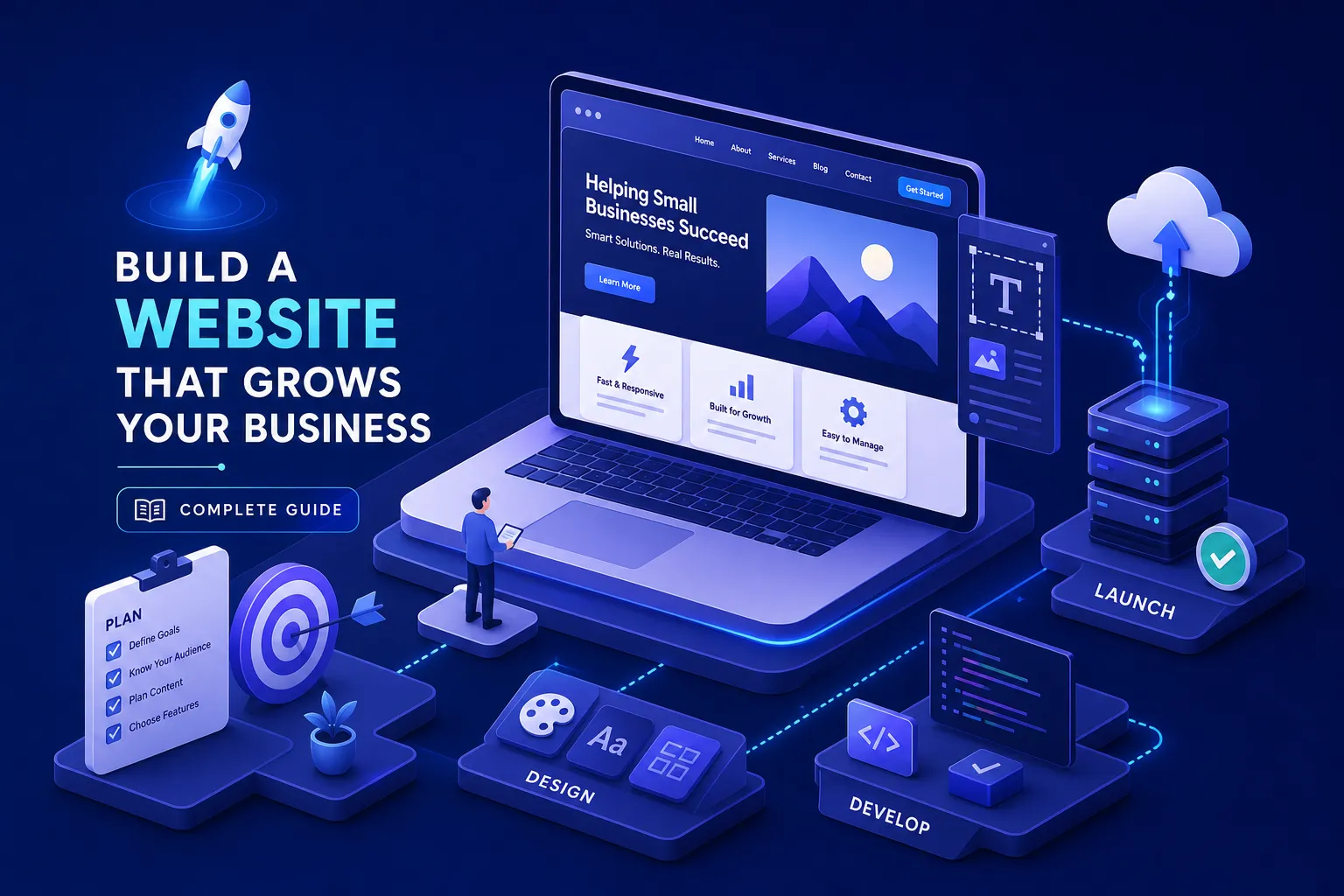

Small business website design in Ghana has a common problem: too many sites exist without actually working. They sit on a server somewhere, load acceptably on a laptop screen, and generate almost no meaningful activity for the business that paid for them. Many lack a clear conversion-focused structure, missing the basic elements that turn visitors into enquiries.
If you've watched visitors land on your site and leave without making contact, you're not dealing with bad luck. You're dealing with a site that wasn't built to perform. At Stayplain Studio, we've built and optimised website designs for small businesses across Ghana, and the problem is nearly always the same: aesthetics got prioritised over outcomes. The site looks fine. It just doesn't work.
Quick Answer: Effective small business website design combines clear, purposeful pages (Home, About, Services, Contact), a strong call to action above the fold, a mobile-responsive layout, fast load times under 2.5 seconds (the threshold Google considers acceptable for Largest Contentful Paint), and on-page SEO built in from the start. Together, these elements move a stranger from first visit to paying customer.
This guide covers everything you need to plan, brief, and build a site that earns its keep. By the end, you'll know which pages to include, where CTAs belong, how to choose between a template and a custom build, which platform suits your needs, and how to brief a designer without wasting time or money. Visit Stayplain Studio's professional website design services if you'd rather have a specialist handle it, but either way, start here.
What a small business website is actually supposed to do
Most owners think of a website as a digital brochure. That framing is what gets them into trouble. A website's job is to move a stranger from awareness to action: getting a quote, making a booking, submitting an enquiry. Looking professional is a side effect of doing that job well, not the goal itself.
Think of two electricians in Accra. Both have websites. One has a sleek design, a gallery of past work, and a long company history section. The other has a clear headline, a "Get a free quote" button above the fold, three client testimonials, and a phone number in the top right corner. The second site is very likely to convert more visitors. The difference isn't budget. It's intent.
The gap between "looking good" and actually converting
A site can look polished and still repel the vast majority of its visitors without generating a single enquiry. Conversion comes from clarity: what you offer, who it's for, and what the visitor should do next. When those three things are obvious very quickly, within a few seconds of landing, the site works. When they're buried under design decisions, it doesn't matter how beautiful the layout is.
Why visitors leave without doing anything
Three things kill conversions on most small business sites. First, the value proposition above the fold is vague or completely missing. Second, there's no obvious next step, the visitor doesn't know whether to call, fill out a form, or keep scrolling. Third, the site loads too slowly on mobile, and patience runs out before the page does. Fix these three problems and you've solved the bulk of your conversion issue without redesigning a single pixel.
Small business website design: the pages and sections every site must have
Core pages your site needs before going live
Your site needs four pages before anything else: Home, About, Services, and Contact. The Home page communicates what you do and who you serve. The About page builds credibility through your story, team, and track record. The Services page explains what you offer, how it works, and why someone should choose you over the next option they'll find on Google. The Contact page makes it effortless to reach you, with phone, email, address, a simple form, and a map if you're a physical business.
These four pages are the standard minimum for a functional small business website. They give visitors a complete enough picture to make a decision, and they give Google enough structure to understand what you do.
The sections inside those pages that actually convert
The hero section at the top of your Home page should contain one headline, a brief supporting line, and one CTA button, nothing else competing for attention. A "how it works" or process block reduces the anxiety visitors feel about what happens after they make contact; it answers the question "what am I signing up for?" before they have to ask. Testimonials placed near your CTAs give hesitant visitors the evidence they need to act. An FAQ block handles objections before they become reasons to close the tab.
Trust signals near CTAs can improve conversions by 15% to 42%, according to A/B testing data from ecommerce and lead-generation sites. That's not a design preference. That's a commercial decision worth making deliberately.
CTAs: what to say and exactly where to put them
For Ghanaian small businesses, the highest-performing CTAs are direct and outcome-focused. "Get a free quote," "Book a consultation," "Call us now," and "Request a callback" consistently outperform vague alternatives like "Learn more" or "Click here." Place the primary CTA above the fold on every important page. Repeat it at the middle and bottom of longer pages. Keep one primary action per page, multiple competing CTAs create confusion and reduce conversions by splitting the visitor's attention.
Match the CTA to the page's intent. An informational blog post should drive a soft action: "Book a free audit" or "Get our checklist." A service page should push directly to "Get a quote" or "Call us today."
Design principles that earn trust before a visitor scrolls
Visual hierarchy: controlling what visitors see first
Your headline, your CTA, and your key benefit should be the three most visible elements on any page. Visual hierarchy is how you achieve that. Larger text, stronger contrast, and deliberate spacing guide the eye toward what matters most. A cluttered layout splits attention across too many elements. A clear hierarchy focuses it on one action, and that focus is where conversions come from.
Mobile responsiveness is a baseline, not a feature
Mobile is the primary channel for most Ghanaian website visitors. A site that isn't mobile-responsive is not a serious business website. Google's mobile-first indexing means your mobile experience directly affects your search rankings, not just your user experience. Responsive design is not a premium add-on you negotiate for. It's the minimum requirement for website design that works in the current market.
Page speed and what a slow site really costs you
Sites ranking on Google's first page load at an average of 1.65 seconds, based on a 2025 analysis of 11.8 million search results. Google's own benchmark considers a Largest Contentful Paint under 2.5 seconds acceptable. If your site takes longer than three seconds to load on a phone, you're losing visitors before they read a single word. The practical fix is straightforward: compress your images, remove unnecessary scripts, and choose a fast hosting provider. Don't save money on hosting and spend it on design, it's the wrong order.
Expert Insight: Page speed affects user behaviour and search rankings simultaneously. On mobile, where Ghanaian users browse across varying network speeds, a slow site loses visitors faster than a slow service loses customers. Build for speed from the start. Retrofitting it later costs more and fixes less.
Template or custom build: making the right call for your budget
What you actually get with a template build
A template-based build is faster to launch and cheaper upfront. For a basic service business that needs a clean online presence quickly, it's a reasonable starting point. The trade-offs are real: design constraints limit how distinctive your site can look, and many small business website templates carry bloated code that slows performance and limits your SEO control. A quality template, chosen carefully and set up well, can serve a small business reliably for two to three years.
When a custom build is worth the higher investment
If your website is your primary lead-generation channel, a generic template will hold you back. When your market is competitive enough that three similar businesses appear alongside you in Google's local results, a template site won't differentiate you. Custom builds give you precise control over performance, SEO structure, and the specific functionality your business needs. That control translates into a measurable competitive advantage in local search over time.
Realistic cost ranges for affordable website design for Ghanaian SMEs
Template-based WordPress sites in Ghana start at around GH₵1,000 on the low end. Custom-built sites start at around GH₵2,000 and rise with scope, additional pages, ecommerce functionality, and specialist features all add to the cost. The cheapest option is rarely the best investment when the site is supposed to generate revenue. See the full breakdown of website design prices in Ghana to understand what different budget levels actually deliver.
Picking the right platform and hosting for your business
WordPress, Wix, Webflow, or Shopify: a plain breakdown
WordPress is the most flexible option and works well for service businesses, content-heavy sites, and small ecommerce setups. It requires more technical maintenance but gives you the highest degree of SEO control and long-term scalability. Wix offers the simplest setup and suits very small businesses with minimal technical needs, though it becomes expensive and limiting as requirements grow. Webflow suits design-forward sites with moderate-to-high budgets. Shopify is the clear choice if selling products online is your primary purpose.
Match the platform to the business. Don't choose based on what your neighbour used or what the developer happens to know best.
Hosting options that work for Ghanaian small businesses
For tight budgets and simple sites, shared hosting from a Ghana-based provider is the practical starting point. Vikalink, based in Kumasi, advertises a 99.99% uptime guarantee and 24/7 support. StormerHost, based in Accra, positions itself around affordable entry-level hosting. Both are among the local options worth comparing for small businesses on a budget. For growing businesses that need better speed and simpler maintenance, managed WordPress hosting is the next step up. When traffic grows consistently, a VPS gives you the performance headroom to scale without service disruption.
Choose a Ghana-based host where possible. Local support, cedi-friendly billing, and faster response times matter when something breaks on a Monday morning before a client presentation.
SEO basics your site needs from day one
On-page SEO: the elements you control directly
Every page needs a unique title tag that includes the main search term for that page. Use one clear H1 per page, followed by logical H2 and H3 subheadings. Place your primary keyword naturally in the first paragraph, in relevant subheadings, and in the alt text for your images, for example, an image alt might read "small business website design example for a Kumasi clinic." Meta descriptions don't directly drive rankings, but they affect click-through rates from Google's results page, which signals relevance. Keep URLs short, clean, and descriptive: /services/website-design performs better than /page?id=47.
Technical and local SEO: what small businesses often skip
An SSL certificate is non-negotiable. A site without HTTPS tells both visitors and Google that the site isn't secure. Beyond SSL, make sure your Google Business Profile is set up and consistent with the name, address, and phone number shown on your website. This consistency is a direct local search ranking signal. Schema markup for local businesses helps Google interpret your business type and service area, which can support richer appearances in local search results.
These technical elements are skipped on the majority of Ghanaian small business sites, which is precisely why fixing them can create a visible competitive edge quickly. Our SEO services in Ghana cover these as a structured, prioritised process rather than a patchwork of fixes.
Expert Insight: Local SEO is where most Ghanaian small businesses leave the most money on the table. A properly configured Google Business Profile, combined with consistent NAP (Name, Address, Phone) data across your website and local directories, can produce significant gains in local search visibility, particularly for businesses in markets with limited direct competition, without spending a single pesewa on paid advertising.
Small business website examples and the lessons inside them
Product-based businesses: strong visuals and clear shopping paths
Hungry Tiger and Jax Snacks are useful reference points for product businesses. Hungry Tiger uses a colour palette aligned to the product, high-quality visuals, lightweight animation, and minimal text so the product stays central. Jax Snacks creates immersion through bold product imagery and interactive scroll prompts that keep visitors engaged without overwhelming them. The transferable lesson: high-quality product photography and a frictionless path to purchase are the two biggest conversion levers for product-based businesses. Everything else is secondary.
Service-based businesses: trust signals and conversion structure
Pristine Carpet Clean is one of the clearer service-business examples: a strong hero image with real people visible, a trust badge near the CTA, intuitive navigation, and an FAQ section that handles objections before they kill a lead. For professional services, clean typography and subtle colour choices signal credibility before the visitor reads a single sentence of body copy. The consistent lesson across these sites: for service businesses, trust is the primary conversion driver. Testimonials, credentials, and a visible CTA near the top of the page do most of the work.
What Ghanaian small businesses can take from these examples
A salon in Kumasi needs a hero image showing the quality of its work, testimonials from real local clients with names attached, a mobile-first layout, and a single "Book Now" button visible without scrolling. A logistics company in Accra needs a clear service overview, a process block that shows how to get a quote, and client logos for credibility. A clinic in Tamale needs a welcoming photo of the facility, a visible phone number in the header, and an FAQ section answering common patient questions.
These are the same structural principles we apply to client projects at Stayplain Studio. You can see how they're put into practice in our design portfolio and review project outcomes in our client case studies.
How to brief your web designer and take control of the project
What to prepare before you talk to any designer
Before you speak to any agency, prepare four things. Know what you need the site to do: generate enquiries, drive bookings, or process sales online. Write a brief description of your target customer, including where they are and what they're searching for. Collect three to five reference sites you genuinely admire, and be specific about what works for you in each one. List the pages you need and the single conversion action you want each page to drive.
This preparation cuts your project timeline and reduces the back-and-forth that inflates costs on both sides.
Questions worth asking any agency before you sign
Ask whether SEO is built into the development process from the start or added as an afterthought after launch. Ask to review the site on mobile before it goes live, not just on a desktop simulator. Ask what post-launch support covers and whether it's included in the project cost or billed separately. Ask for examples of comparable work from businesses of similar size and industry. The quality of those answers tells you quickly whether the agency is a growth partner or just a vendor selling a deliverable.
Small business website design that works, not just one that exists
A small business website that earns its keep combines the right pages, clear CTAs, trust signals, mobile performance, and SEO structure built in from day one. Agencies that treat small business website design as an engineering problem, solving for both search visibility and sales conversion, produce measurably different outcomes from those that treat it as a design exercise. One approach gives you something that looks good at launch. The other gives you a commercial asset that compounds in value over time.
Explore our web design approach for Ghanaian businesses and see how we build sites that are engineered to rank and convert, not just to impress at a client presentation.
Build with purpose, not just with a budget
The knowledge in this guide is enough to plan a site that performs. You know which pages matter, where CTAs belong, what trust signals to use, how to choose a platform and host, what SEO to implement from the start, and what real-world examples look like. That's a solid foundation most business owners don't have when they commission their first website.
The remaining question is execution. You can build it yourself using a quality template, a managed WordPress host, and the structural framework above. Or you can work with specialists who've done it repeatedly for small businesses in a market like yours, with the results to show for it. Either way, the brief is the same: build a site that works, not just one that exists.
If you want a second pair of eyes on what you currently have, request a free website audit from Stayplain Studio. We'll tell you plainly what's working, what's hurting your conversions, and what to fix first. No sales pitch. Just a straight answer.
💬 Prefer to talk first? Chat with us on WhatsApp and we'll respond quickly. The first conversation is often where the clearest opportunities become visible.