

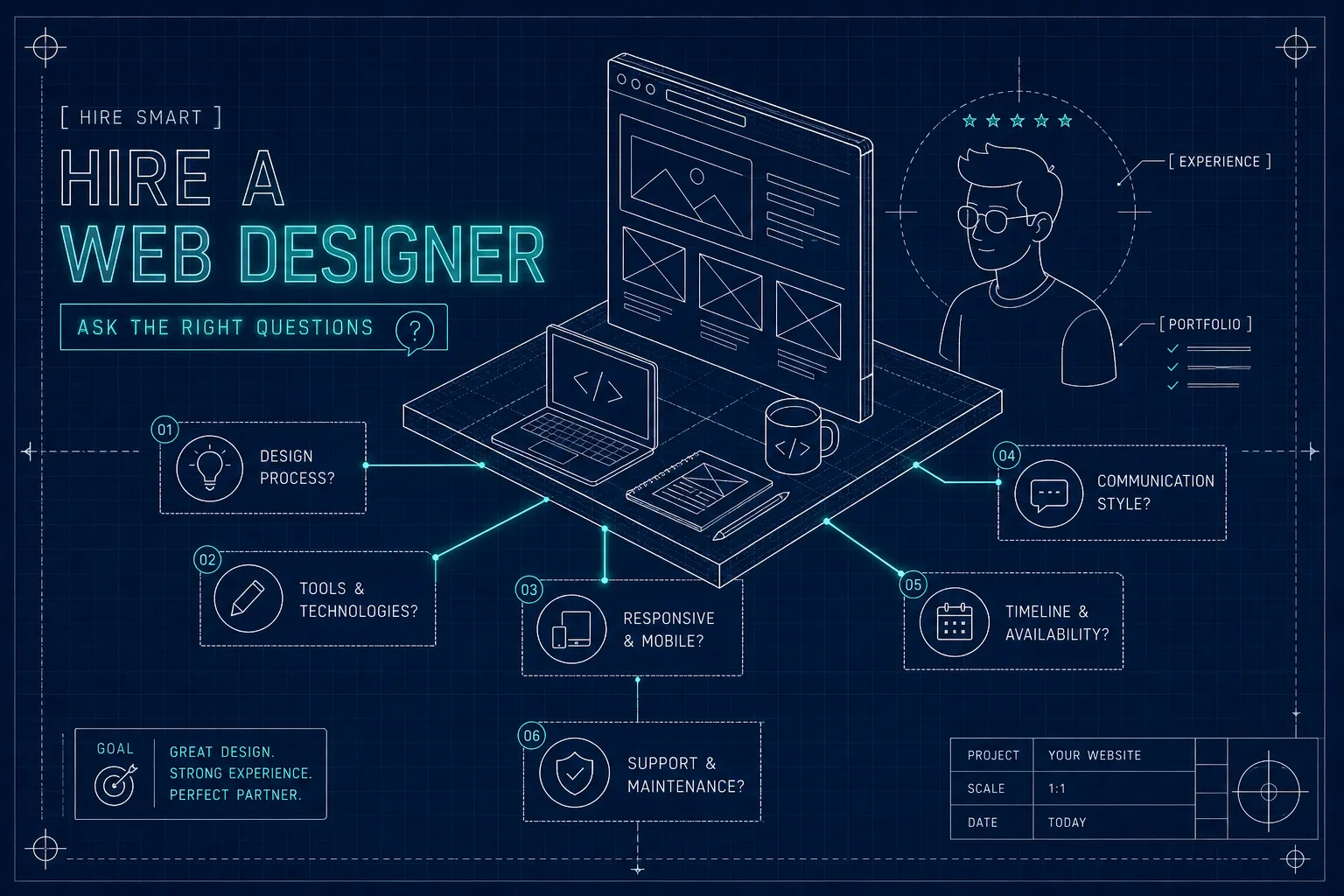

Before you hire a web designer, understand what a bad hire actually costs. It is not just money. It is months of waiting, followed by weeks of back-and-forth, followed by the realisation that what you received cannot rank on Google, does not load properly on mobile, and looks nothing like what you agreed to. By the time you figure that out, your original budget is gone and you are starting from scratch.
At Stayplain Studio, we have spent over a decade building websites for businesses across Ghana. In that time, we have reviewed hundreds of project briefs and seen exactly what separates a smart hire from an expensive lesson. The difference is almost never about talent. It is about asking the right questions before any money changes hands.
This guide gives you everything you need to make a confident decision: which hiring route to take, a checklist of direct questions, realistic Ghana pricing benchmarks for 2026, and a project brief template you can send today. If you want to explore professional website design services in Ghana built around business results rather than aesthetics alone, start there. For now, here is what you need to know before you hire anyone.
Quick Answer: To hire a web designer successfully, review their portfolio for measurable results (not just visuals), ask about their SEO knowledge and handover process, confirm who owns the finished site, and match their rate to your project scope. In Ghana, freelance web designer rates range from $9, $80/hr depending on experience; agency projects for small businesses typically start in the mid-thousands of dollars and scale upward based on scope.
What the wrong hire actually costs you
Consider a straightforward scenario. You pay a designer GHS 4,000 upfront. Three months pass with occasional WhatsApp updates and vague reassurances. What you receive is a slow site, built on a poorly configured theme, with no meta titles, no mobile responsiveness, and images so large they take eight seconds to load on a phone in Accra. You cannot edit the content yourself. The designer says revisions will cost extra. You are now further back than when you started.
This is not a rare case. It is the most common outcome when clients skip the vetting process and hire on instinct. The money lost to unusable work is frustrating, but it is rarely the biggest cost. The bigger cost is the revenue that never came because the site failed to rank, failed to convert, or simply never launched at all.
The three ways a bad web designer wastes your money
Most losses from a poor hire fall into three categories. First, there are the direct fees paid for work that cannot be used. Second, there is the cost of rebuilding, which often exceeds the original project budget because a new designer must clean up someone else's mess. Third, and most significant, is the revenue never generated because a slow, unoptimised site with no SEO foundation will not rank on Google and will not convert visitors into paying customers. That last cost is invisible on paper, but it is real.
Why most hiring decisions go wrong from the start
The mistake almost always happens at the brief stage. Businesses hire based on an attractive Instagram portfolio, a friend's recommendation, or a low quote that seems like good value. Nobody asks about SEO knowledge, handover process, or code ownership. Nobody defines revision rounds in writing. By the time problems surface, the relationship has soured and the contract, if there was one, is too vague to enforce. The checklist in this article exists precisely to prevent that.
Three hiring routes: which one fits your situation
There is no single right answer here. The correct route depends on your budget, your timeline, and how much project management you are willing to do yourself. Here is a breakdown of each option.
Freelancer: fast and affordable, but all on you
A freelancer is a good fit when your project scope is narrow, your budget is tight, and you have the time and confidence to manage the work yourself. Platforms like Upwork and Twine let you see verified reviews, hourly rates, and portfolio samples before reaching out. The risk is that quality control, communication, and contract enforcement rest entirely on you. Always use a written agreement, regardless of how casual the relationship feels at the start.
Marketplace platforms: what they offer Ghanaian businesses
Clutch and DesignRush list vetted agencies and allow you to compare service offerings, pricing ranges, and client reviews in one place. They are most useful when you want a shortlist of credible options without doing all the research yourself. Upwork and Twine surface freelancers with visible ratings and transparent rates. The advantage of these platforms is the transparency they provide. The gap is that a strong profile does not always translate to business results, which is why you still need to ask the questions covered later in this article.
Agency: when paying more is the smarter move
An agency gives you a coordinated team: designer, developer, and often an SEO specialist working together on your project. That coordination becomes especially important on larger projects where scope and integrations grow. At Stayplain Studio, design, SEO optimisation, and conversion strategy are handled together from the start. The site is built to rank and sell from day one, not just look good in a browser. If your business depends on this site generating leads or sales, paying for an agency is not an expense. It is an investment in a system that works.
How to read a portfolio like a client, not an admirer
Beautiful design and business results are not the same thing. A visually impressive site that does not convert visitors, load quickly on mobile, or rank on Google is still a failure. When reviewing a designer's portfolio, you are not looking for work that you find attractive. You are looking for evidence that the designer's decisions produced measurable outcomes for their clients.
What a strong case study actually proves
A useful case study answers three questions: what was the client's problem, what specific decisions did the designer make, and what changed as a result? If a portfolio page shows a polished screenshot without any of that context, it tells you nothing about how the designer thinks or whether they can solve your specific challenge. Look for conversion improvements, mobile performance data, traffic growth, or lead volume increases as outcomes. At Stayplain Studio, our portfolio documents the problems clients brought to us and what changed after we built their sites. That is the standard you should hold any designer to.
Four red flags to watch for before you move forward
- No live links to finished projects, only static screenshots
- Case studies that focus on the designer's creative process without mentioning client results
- Portfolios made up entirely of template-based work with no visible customisation
- No mobile-optimised examples, which is a non-negotiable standard in 2026
If a designer cannot show you a live project with documented outcomes, they have not yet proven they can deliver business results. Keep moving until you find one who can.
The questions that expose a weak designer fast
There is nothing subtle about this. Ask these questions directly, listen carefully to the answers, and pay attention to how comfortable the designer is with specifics. Vague answers to specific questions are information. They tell you what working with this person will feel like at 11pm when something breaks after launch.
Questions about communication and process
- "What does your typical project timeline look like from brief to launch?""How many revision rounds are included, and what happens if I need more?"
- "Who is my main point of contact, and how often will you update me?"
- "Have you worked with businesses in my industry before, and can you share an example?"
A confident, experienced designer answers these without hesitation. They have a process, they follow it, and they can describe it clearly. If the answers are vague or overly flexible, that flexibility will cost you later.
Questions about handover, ownership, and support
- "Who owns the website code and all design assets after launch?"
- "Will I be able to edit the site myself once it is live?"
- "What happens if something breaks after handover?"
- "Is post-launch support included in the fee, or is it billed separately?"
These questions protect your investment directly. A professional designer answers them without hesitation or defensiveness. If they stall, become evasive, or frame ownership as something to be negotiated later, that is your cue to walk away. You should own your website outright after paying for it. That is not a negotiating point; it is a basic professional standard.
How to hire a web designer who actually understands SEO
A site that looks good but does not rank is a decorative expense, not a business asset. Many web designers in Ghana produce visually appealing sites with no SEO foundation built in. The site launches, nobody finds it, and the client assumes SEO is a separate conversation to have later. It is not. SEO must be built into the architecture from the start.
What a designer should know about on-page SEO
Ask directly: "How do you handle on-page SEO during a build?" A competent answer covers clean URL structures, properly formatted meta titles and descriptions, heading hierarchy, image optimisation with descriptive alt text, schema markup, internal linking structure, and page speed optimisation. If the answer is "I can install an SEO plugin for you," that is a warning sign, not a solution. Plugins are tools. Understanding what to do with them is the skill. At Stayplain Studio, every site we build is engineered to rank from the ground up. That is the standard you should expect from any designer you hire. You can also explore our standalone SEO services in Ghana if your existing site needs a technical foundation review.
Mobile performance and Core Web Vitals: why they matter
Google uses mobile-first indexing, meaning it ranks and evaluates your site based on the mobile version first. Poor mobile performance and weak Core Web Vitals scores directly harm your search rankings. A site that loads slowly on a phone in Kumasi will struggle to rank, regardless of how sharp it looks on a desktop monitor. Ask any designer you are considering for a PageSpeed Insights score on one of their live projects. A professional knows these numbers and can explain the decisions that produced them. If they look at you blankly, the mobile experience your customers receive will reflect that gap directly.
Hire a web designer in Ghana: pricing and timelines
Pricing confusion leads to poor decisions on both ends: businesses underbudget and end up with underpowered sites, or they overpay without understanding what they are getting. Here are realistic figures so you can budget before your first conversation with any designer.
What web designer rates actually look like right now
Freelance web designers in Ghana charge roughly $9, $20/hr at entry level, $20, $45/hr at mid-level, and $45, $80+/hr for experienced specialists. For fixed-project work, typical ranges are:
- Simple brochure site: $500, $1,500
- Custom small-business site: $1,500, $5,000
- Complex or e-commerce build: $5,000, $10,000+
Agency projects in Ghana are generally priced higher than freelance work, reflecting the coordinated team and broader service scope. Costs scale based on complexity, integrations, and post-launch support included. For transparent, current local agency pricing broken down by project type, visit Stayplain Studio's pricing page.
How long each project type typically takes
Timelines are as important as pricing when setting expectations. Plan for the following ranges:
- Brochure or small-business site: 4, 8 weeks
- E-commerce site: 6, 12 weeks
- WordPress customisation (light): 2, 6 weeks
- WordPress customisation (complex): 8, 12+ weeks
These timelines assume content is ready on your side from the start. The single most common reason projects run over is delayed client feedback and missing copy or images. Have your content prepared before the build begins, and your timeline will hold.
Contract basics every small business must include
A verbal agreement is not a contract. A WhatsApp confirmation is not a contract. In Ghana, where digital contracting culture is still developing, written agreements protect both parties clearly and prevent the kind of disputes that end business relationships and leave websites unfinished.
Payment milestone structure that protects both sides
Avoid paying in full upfront under any circumstances. The two structures that work well for small business website projects are the 50/50 split (half on project start, half on final delivery) and the 33/33/34 arrangement (one-third at start, one-third at a defined midpoint, the balance on launch). Each payment should be tied to a specific deliverable: homepage design approval, staging site sign-off, or full launch readiness. The contract should state clearly that work can pause if a milestone invoice is overdue. That clause protects the designer's time and motivates the client to keep feedback moving.
IP ownership and rights: who gets what
After full payment, you must own the finished website, its source code, and all custom design assets. This should be stated explicitly in writing, not assumed. Stock photos, licensed fonts, and third-party plugins are separate items: the client may need individual licences for these, and a professional designer will acknowledge this upfront and document it clearly in the contract. If a designer is reluctant to discuss ownership before the project starts, treat that as a significant warning sign. Our case studies show the kinds of outcomes that come from clear, professionally structured projects where scope, ownership, and deliverables are defined before a single pixel is designed.
Write a project brief in 15 minutes and start hiring today
You do not need a 20-page document to start the hiring process. A clear, concise brief gives any professional designer everything they need to quote accurately and start conversations that go somewhere useful.
The six things every brief needs
A strong web design brief covers six points. First, what your business does and who it serves. Second, the primary goal of the site: leads, sales, bookings, or brand awareness. Third, two or three examples of websites you like and a sentence on what specifically appeals to you about each. Fourth, the pages required and any specific features (contact forms, booking systems, product catalogues). Fifth, your budget range, stated honestly. Sixth, your target launch date. In most cases, these six points are sufficient for a designer to provide an initial quote; complex builds may require more detail at the next stage, but this is enough to begin.
Where to send that brief first
If you want to work with an agency that already meets every standard covered in this guide, documented portfolio results, SEO-optimised builds, clear contracts, and post-launch support, Stayplain Studio is the place to start.
We have built websites for NGOs, health clinics, solar energy companies, and e-commerce brands across Ghana. We have achieved substantial domain authority increases for clients and resolved technical issues including malware, Google deception warnings, and Search Console indexing errors for sites whose online presence was effectively broken. Our work is designed to rank on Google and convert visitors into paying customers, not simply look good in a proposal deck.
When you are ready to hire a web designer, send us your brief and we will review it for free. You can also take advantage of our free website audit if you already have a site and want an honest assessment of what is holding it back. Reach out through our contact page or message us directly on WhatsApp. The conversation costs you nothing. A poor hire will cost you far more.