

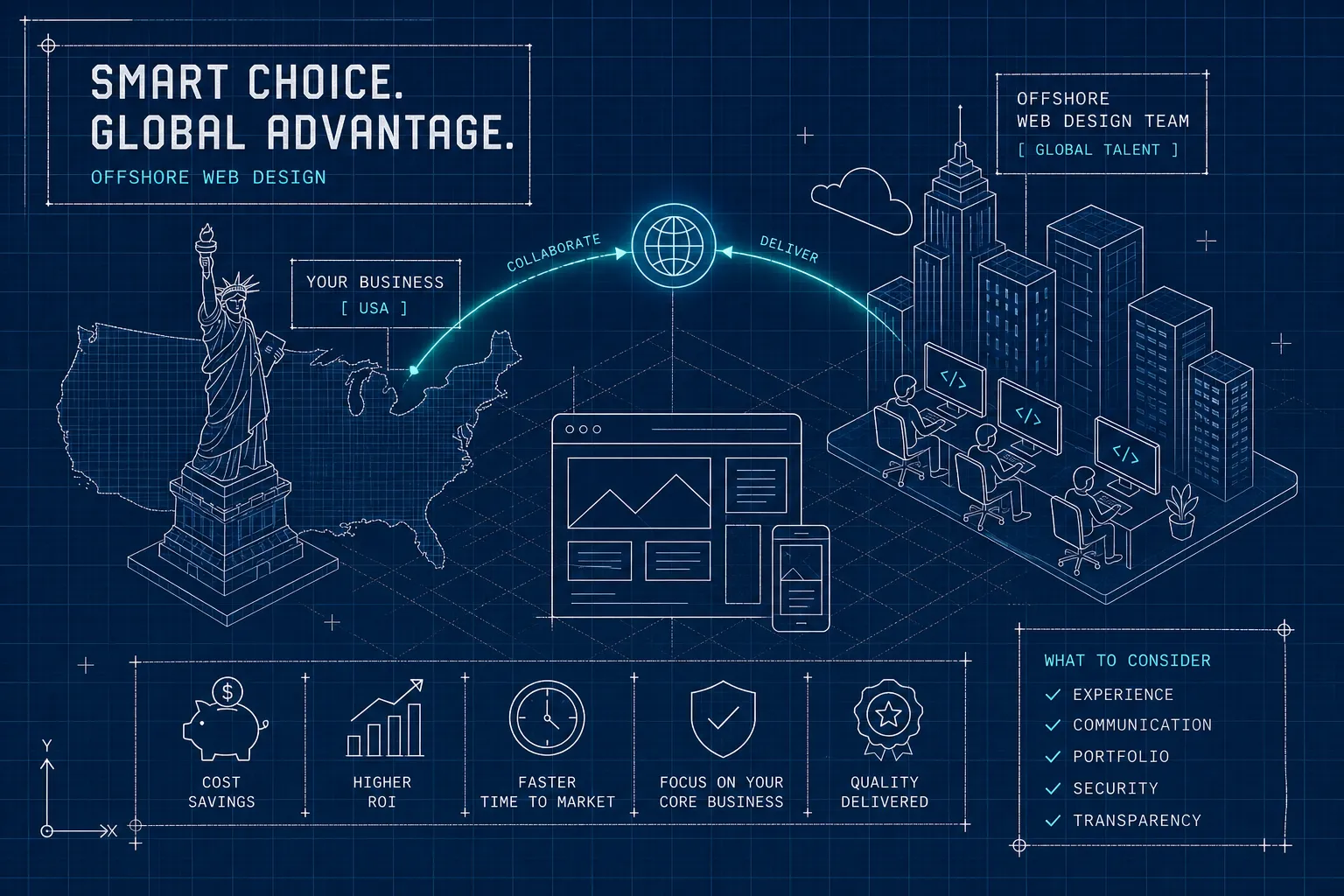

Offshore web design works. That is not a question. The question is whether your business is approaching it like a real procurement decision or like a quick fix for a tight budget. Many companies that get burned offshore did not choose the wrong country; they wrote a vague brief, skipped the vetting process, and then blamed the geography when the project fell apart. If your team is considering offshore web design, treat it as a procurement decision: scope, vetting, and communication matter most.
Quick Answer: Offshore web design means hiring a web design agency or designer outside the United States, typically in regions such as Africa, South-East Asia, or Eastern Europe. Done correctly, it can reduce project costs substantially, one comparison puts a US agency build at $15,000, $40,000 against an offshore equivalent at $5,000, $12,000, without sacrificing quality. Three conditions determine whether it works: vet the vendor on process and portfolio, structure the engagement with a proper contract, and manage communication deliberately. Geography matters less than those three things combined.
Ghana-based studios like Stayplain Studio are producing work for international clients at rates well below US agency pricing. This article gives you the framework to evaluate any offshore vendor confidently: cost benchmarks by region, a vetting checklist, RFP essentials, communication models, and a clear example of what a quality offshore partnership actually looks like in practice.
Why US businesses are moving web work offshore
The driver is not desperation. Businesses that outsource website development to offshore teams are, increasingly, making a deliberate strategic choice. They are accessing a global talent pool, compressing timelines through time-zone coverage, and scaling project teams for a sprint without committing to full-time hires. Cost is part of the equation, but it is rarely the only part.
The real cost gap between US and offshore rates
US web design agencies charge widely varying hourly rates depending on seniority, location, and specialisation, often ranging from $75 to well above $150 per hour for established firms. A mid-complexity responsive website typically runs $10,000 to $40,000 for a small to mid-size business, depending on scope and agency tier. That same scope, delivered by a reputable offshore agency, often lands between $5,000 and $12,000. On a $20,000 project, that gap is material, not marginal, it is budget that could fund a marketing campaign, a sales hire, or several months of paid search.
When offshore makes less sense
Be honest about the trade-offs. If your project requires deep US regulatory compliance built into the UX, heavy in-person design workshops, or same-day turnaround on revisions, offshore adds friction. Offshore is the wrong model if your process depends on walking down the corridor to talk to someone. It works best when you can define deliverables clearly, review work asynchronously, and commit to a structured engagement model.
What offshore web design actually costs in 2026
These are the working benchmarks for 2026. Use them to sanity-check any quote you receive. A proposal that falls significantly below these ranges is not a bargain; it is a warning sign about what corners are being cut on process, seniority, or quality assurance.
Hourly rates by region
| Region | Typical hourly rate (2026) |
|---|---|
| Philippines | $15, $35/hr |
| India | $10, $50/hr |
| Eastern Europe | $25, $58/hr |
| Africa | $20, $45/hr |
India shows the widest spread because the market runs from solo freelancers charging $10 per hour to senior agency teams billing $50. Africa sits competitively between the Philippines and Eastern Europe, with a growing quality track record that the rate alone does not yet reflect. The gap between what African agencies charge and what they deliver is narrowing, and many US buyers are only now beginning to take that seriously.
Project cost ranges by scope
Scope drives cost more than geography. A poorly scoped project will run over budget in any region. These are the practical offshore project ranges for 2026:
- Landing page: $150, $500 per page
- Startup or brochure marketing site: under $10,000
- Responsive CMS build: $2,000, $20,000
- Complex e-commerce or product site: $50,000 and above
For transparent reference on what quality offshore web design realistically costs, Stayplain Studio publishes its website design prices openly. That kind of pricing transparency is itself a signal about how an agency operates.
Matching the right region to your type of web project
Not every offshore market is equally strong at every type of web work. The right choice depends on what you are actually building and what matters most to your project: design sophistication, technical depth, communication fluency, or time-zone alignment.
UX and design-heavy projects
Ukraine, Poland, and the Philippines have established reputations for offshore UX/UI design work, built on strong design education, solid English communication, and alignment with Western market expectations. Africa is gaining ground fast, particularly for conversion-focused design where the brief is commercially oriented rather than purely aesthetic. If you are building something that needs to perform as well as it looks, the African market deserves evaluation alongside the traditional options.
Frontend and full-stack builds
India and Vietnam lead on volume and cost for offshore web development at the frontend level. Eastern Europe and Latin America offer better work-culture alignment and stronger English fluency for complex full-stack projects where communication during architecture decisions is critical. If your project involves significant backend integration or custom application logic, Eastern Europe or Latin America typically performs better on the coordination side than the lowest-cost South-East Asian options.
Africa as an established, underestimated option for nearshore web design
Ghana in particular combines strong English fluency, a GMT time zone with a workable 2, 4 hour overlap with US Eastern time, and a maturing pool of designers and developers who have been building for international clients for several years. The country's digital economy has grown steadily, and the agencies that have been doing this work longest now have portfolio depth to prove it. Dismissing Africa as "emerging" misses what is already happening on the ground.
How to vet an offshore web design agency before you sign anything
This is where most procurement processes break down. US businesses often evaluate offshore vendors on price and aesthetics alone, then wonder why delivery fails. The vetting framework that actually works focuses on process evidence, not just output samples. When you hire an offshore web designer or agency, the quality of their process documentation is as telling as their portfolio.
What to look for in their portfolio and case studies
Ask for case studies that show before-and-after results, not just screenshots. Look for evidence of SEO performance improvements, page speed scores, and conversion outcomes. Any offshore agency worth hiring should be able to document results, not just aesthetics. For a practical example of what transparent case study documentation looks like, review Stayplain Studio's case studies, which show specific client outcomes including domain authority growth and traffic improvements.
Also review their full portfolio for breadth of project type and consistency of quality across different industries and scopes. An agency that only shows its best three projects is hiding something. An agency with fifteen varied, documented projects is showing you a real body of work.
The process questions that separate serious agencies from order-takers
Ask these specific questions before you sign anything: How do you handle scope changes? What is your QA process? Who does the actual work, in-house team or subcontractors? What project management tools do you use? What does your handoff process include?
Agencies with a real process answer these questions specifically and confidently. Agencies that give vague or general answers are typically freelancers operating behind an agency facade, and that matters enormously when a project hits a problem mid-build.
Red flags that should end the conversation immediately
Stop talking to an offshore web design agency if they do any of the following: ask for project details before signing an NDA, deliver an unusually rapid and highly detailed quote for a complex brief without evident due diligence, refuse to provide client references, are unable to explain their testing process, or push for full payment upfront. These are not negotiating points. They are indicators of how the agency operates under pressure, and pressure is inevitable in any web project.
Time zones and communication: the part most businesses get wrong
The majority of offshore project failures trace back to communication structure, not technical capability. The time-zone gap is real, but it is entirely manageable with the right model. The mistake is trying to replicate a US in-office collaboration rhythm with an offshore team. That model does not scale across eight to ten time zones.
The 2, 4 hour daily overlap rule
For US businesses working with Ghana-based teams, there is a workable 2, 4 hour overlap in early US mornings. Use that window for standups, design reviews, and clearing blockers. Everything else runs asynchronously. Trying to squeeze real-time collaboration outside that window creates frustration on both sides and degrades response quality. Protect the overlap window; it is your most valuable communication asset in an offshore engagement.
Sprint cadence and tool stack that actually works
Use 1, 2 week sprints for web design work. Keep task tracking centralised in one tool: Asana, ClickUp, or Trello all work. Use Slack for real-time communication during the overlap window and Loom or short video for design feedback. Video feedback reduces miscommunication significantly compared to long written paragraphs, the reviewer can show what they mean visually rather than describing it in text open to interpretation. Write response-time expectations into the contract from day one, and define clearly what constitutes a blocker versus a routine request.
What your RFP and contract must lock down
Vague contracts produce vague results. The contract is where you define what "done" actually means, and it is the only protection you have if the engagement goes wrong. These are the non-negotiable items.
Scope, milestones, and acceptance criteria
Define every deliverable explicitly: page count, templates, responsive breakpoints, CMS setup, source file formats, and handoff documentation. Tie payment to milestone acceptance, not calendar dates. Define "done" for each milestone, including browser compatibility requirements, performance thresholds (Google's Core Web Vitals targets are a reasonable baseline), and defect limits before sign-off. If it is not written down, it does not exist.
IP ownership, NDA, and third-party assets
State clearly in writing that all custom design work, code, and graphics are assigned to your company upon final payment. Do not rely on payment alone to transfer ownership; without a written assignment clause, the creator retains the copyright in most jurisdictions. Require full disclosure of any third-party libraries, open-source components, or stock assets, with proof of valid licence. Sign the NDA before sharing any business details. This is not bureaucracy; it is basic protection that serious agencies expect and have no objection to.
Payment structure, warranty, and exit rights
Use milestone-based payments without exception: a deposit to start, a mid-project payment tied to design approval, and a final payment on launch acceptance. Require a post-launch bug-fix period of 30, 90 days as standard. Include a termination clause that requires the vendor to hand over all work-in-progress files, credentials, and backups immediately upon exit. That last clause is the one that protects you if the relationship breaks down, and the fact that a vendor objects to it tells you everything you need to know about their intentions.
Stayplain Studio: what a quality Ghana-based offshore partner actually looks like
We built Stayplain Studio around a specific proposition: websites engineered for both search engine performance and sales conversion, not just aesthetics. That distinction matters for US clients who need a site to rank on Google and turn traffic into revenue, not just look good in a portfolio screenshot. Based in Kumasi and serving clients across Ghana and internationally, we have spent years building the portfolio depth and process rigour that offshore procurement should demand.
The work and what it shows
Our documented results include growing Chloe International's website SEO authority from DA 7 to DA 50 over three months. We have also delivered SEO link-building programmes for US-based clients including Coverking Auto, and built full SEO-optimised websites from scratch for NGOs, health clinics, and solar companies in Ghana where there was previously no online presence at all.
We also handle post-launch security work: malware removal, Google Search Console indexing fixes, and deceptive-site warning resolution. Many design-focused agencies do not specialise in that kind of technical remediation. We document the work and the results because that is what accountability looks like. For full context, our case studies set out specific client outcomes with detail.
For US businesses evaluating our approach and scope, our website design services page covers what we build and how, and our full agency overview at Stayplain Studio gives a complete picture of what working with us involves from brief to launch.
The cost comparison that makes the case
A mid-complexity responsive website with SEO optimisation from a US agency typically runs $15,000, $30,000, depending on scope and agency tier. Stayplain Studio's outsourced website development model delivers comparable output at significantly lower cost, a structural advantage that comes from operating in Ghana with a team that has been doing this work seriously for years, not a temporary discount. That is the offshore value proposition working as it should: disciplined process, documented results, and a lower cost base.
Quality pitfalls that sink offshore projects and how to prevent them
The honest accounting of what goes wrong offshore is this: it is rarely the talent. The failures that get blamed on offshore vendors are almost always the result of unclear requirements, absent QA processes, and no structured milestone reviews. Offshore teams cannot produce quality against a vague brief, and neither can domestic ones.
Build QA into the process, not onto the end of it
Reputable offshore web design agencies run structured QA throughout the build: cross-browser testing, performance testing, and user acceptance testing at each milestone. They do not run a single round of checks the week before launch and call it done. Require this in writing before you sign. Ask specifically how the agency tests for mobile responsiveness, page speed, and browser compatibility. A vague answer is itself an answer about their process maturity.
Standards to require from any offshore team you hire
For development quality and security, reference the OWASP Top Ten as a baseline requirement for any site handling user data or integrations. Require documented coding standards and regular code reviews. Insist on automated testing and continuous integration for anything beyond a simple brochure site. Offshore teams that already operate at this standard will answer these questions without hesitation because the process is already in place. Teams that cannot answer them clearly are improvising, and improvisation is expensive to fix after the fact.
Make the decision with your eyes open
Offshore web design is not a gamble. It is a professional procurement decision, and the businesses that get it right treat it that way from the start. The geography is less important than the agency's process, portfolio depth, and communication model. You now have a framework for every decision in that chain: budgeting by region and scope, vetting by portfolio and process evidence, protecting the engagement via RFP and contract, and managing delivery with a clear communication structure.
For US businesses that want quality work without paying US agency rates, Ghana-based offshore web design partners with documented international track records represent a serious option. Stayplain Studio has the case studies, the client results, and the process to back that up. If that combination is worth a conversation, the starting point is our contact page. Bring your brief, your budget range, and your questions. We will give you straight answers.