

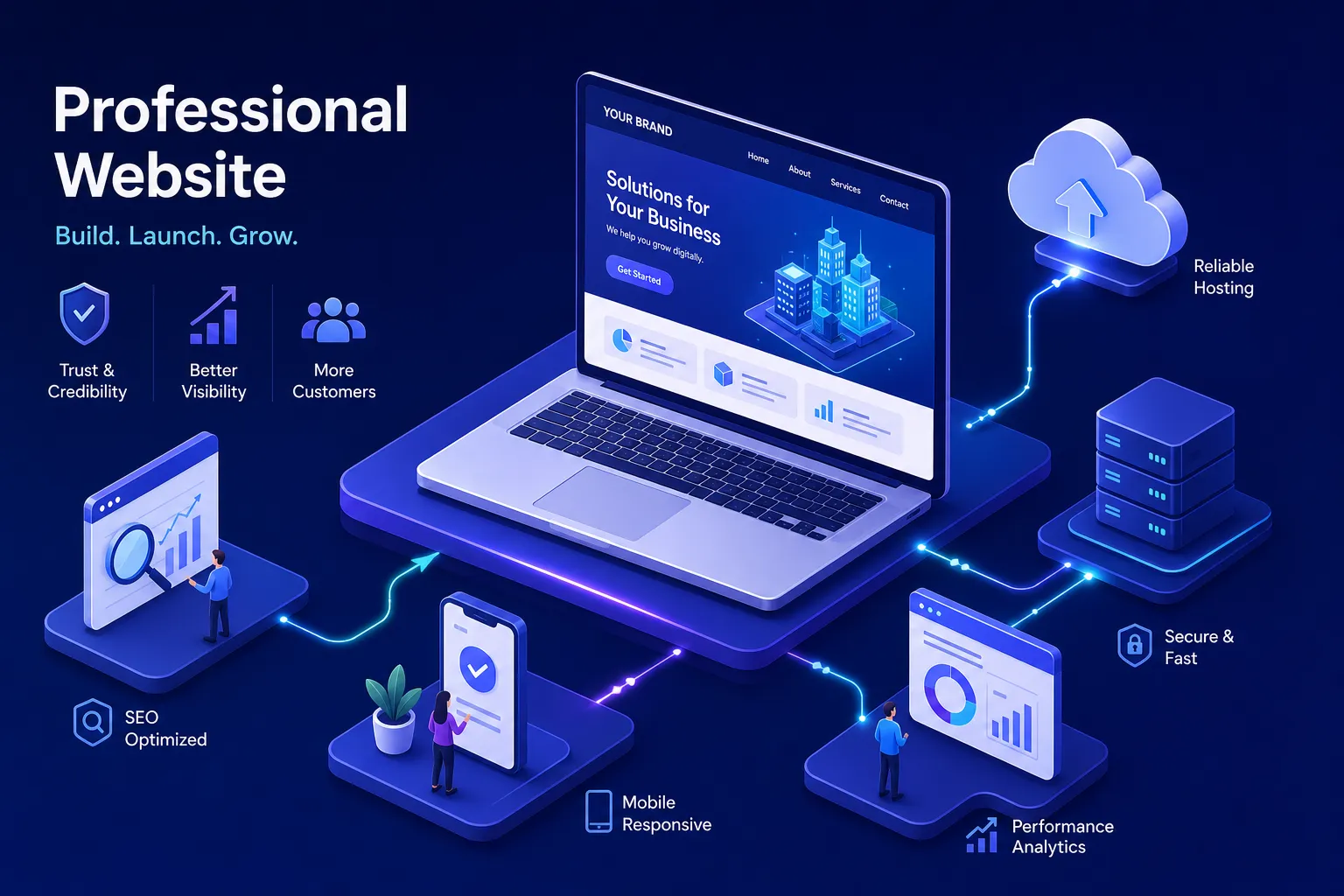

Many businesses focus primarily on visual design when they think about a professional business website . That focus alone is costing them leads, credibility, and revenue they do not even know they are losing.
A professional business website design earns trust on the first visit, ranks on Google, loads fast on a mobile phone, and converts strangers into paying customers. Design is just one layer of that equation. If you want professional business website design that actually drives results, you need to look beyond aesthetics and think seriously about performance, structure, and strategy.
Quick Answer: A professional business website combines credible visual design, strong technical SEO, fast mobile performance, and clear conversion pathways. It is not defined by aesthetics alone, it is defined by how well it ranks on search engines, how fast it loads, how much trust it builds on arrival, and how effectively it turns visitors into paying customers.
At Stayplain Studio, we have built websites for businesses across Ghana, from Kumasi to Accra to Tamale, and one pattern holds: the sites that bring in real leads are rarely just pretty. They are engineered. By the end of this article, you will know exactly what separates a professional business website from an expensive digital brochure, and what to do about it.
What a professional business website actually signals to buyers
The first impression visitors form in seconds
UX research consistently shows that visitors form strong opinions about a website within a few seconds of landing on it, often before they read a single word. Visual trust signals dominate that judgement: layout, colour balance, spacing, font choices, and logo quality all register immediately. A site that feels dated or visually chaotic sends one clear message: this business is not serious.
This is not a design preference. It is buyer psychology. When someone lands on your site for the first time, their brain is answering one question: "Can I trust this business?" Your site either answers that question clearly or it does not. There is no neutral position.
Professional design as a proxy for business quality
When a buyer cannot physically visit your office or inspect your product, your website becomes the business. A polished, well-structured site signals that you pay attention to detail, that you are established, and that you are trustworthy. Look at how firms like McKinsey and Deloitte approach their sites: they lead with outcomes and visible proof, not self-congratulation. The design communicates quality before the copy even loads.
For Ghanaian SMEs competing for corporate clients, this matters enormously. A corporate buyer in Accra researching HR consultants or logistics partners will form an opinion of your business within seconds. Your website is either closing that gap or widening it.
What an unprofessional website actually costs you
An underperforming website is not neutral. It actively costs you enquiries, credibility, and sales. Every visitor who leaves without contacting you is a missed opportunity, and those losses compound over months and years. For a Ghanaian small business competing for B2B contracts or high-value customers, a weak website is not merely a design problem. It is a revenue problem.
Small business website design: the visual markers that build instant credibility
Typography and layout hierarchy
Strong typography signals clarity of thought. Large, bold headlines allow visitors to scan the page rapidly and understand the offer in seconds. Clear visual hierarchy, from headline through subheading to body copy, combined with generous whitespace communicates that this business values the reader's time. Cluttered layouts erode trust, even when the content itself is solid.
This is not about following design trends for the sake of it. It is about giving the visitor the fastest possible route to deciding that you are the right choice. Every element on the page should either build confidence or move the visitor toward contact.
Imagery, colour, and visual consistency
Generic stock photos undermine credibility immediately. Visitors have seen the same posed handshake image on a hundred sites. Authentic team photos, real product images, and consistent brand colours send a different signal: this is a real business with real people. Deliberate colour consistency, a restrained palette applied across buttons, headings, and accents, can communicate quality without saying a word.
The dominant trend in 2026 is minimal, conversion-focused layouts rather than visually crowded pages. That does not mean boring. It means every visual element earns its place by supporting the business case.
The UX trends worth following in 2026
The strongest design patterns right now combine mobile-first layouts, data visualisation for proof-heavy sections, and strategic use of motion that supports rather than distracts from the message. Bento-style grids and asymmetric layouts can add personality when they serve readability. What they should never do is slow the page down or obscure the call-to-action. Trends should support the business case, not decorate the page.
Key Principle: The businesses with the highest-converting websites in 2026 are not the ones with the most impressive visual effects. They are the ones that made it easiest for a visitor to understand what they do, trust that they do it well, and take the next step. Simplicity is the strategy.
SEO structure: the layer most web designers leave out
Why design and SEO must be built together
A beautiful site that no one finds is not a professional business website. It is an expensive brochure. SEO architecture, heading hierarchy, page speed, semantic HTML, and internal linking, must be part of the build from day one, not bolted on later. Many designers treat SEO as secondary, or skip it entirely. The result is a site that looks good in a portfolio and does nothing for the business that paid for it.
At Stayplain Studio, every website build starts with SEO structure at the wireframe stage. If you want specialist support beyond the initial build, our SEO services in Ghana cover the full technical and content layer that makes a site competitive on Google.
The technical SEO elements most sites skip
A properly structured site covers several non-negotiable elements:
- A single descriptive H1 per page
- A logical H2 and H3 heading structure that mirrors content hierarchy
- Clean URLs containing target keywords
- XML sitemaps submitted to Google Search Console
- Schema markup for your business type, services, and FAQs
- Meta descriptions written to earn the click
Each element is a signal to Google about what the page covers and who it serves. Skip them and you are relying on luck rather than strategy.
Keyword mapping matters equally. Each page should target one primary search intent with a small cluster of related terms. Pages competing with each other for the same keyword dilute your site's authority and confuse search engines about what to rank.
Local SEO for Ghanaian businesses
For Ghanaian SMEs, local search visibility is not optional. Someone searching "web designer in Kumasi" or "accountant in Accra" should find you. That requires a verified Google Business Profile, consistent name, address, and phone number information across the web, location-specific pages with unique content, and where relevant, your GhanaPostGPS address. Local SEO is how a small business competes with larger competitors in a specific geographic market, and it is one of the highest-return investments a Ghanaian business can make in its digital presence.
Security and the trust signals visitors notice immediately
SSL certificates and HTTPS: the minimum standard
An HTTP site displaying a browser warning that reads "Not Secure" significantly harms perceived trust and can increase bounce rates. SSL certificates encrypt the connection between your site and your visitor's browser, and they are now a baseline requirement for any site that collects enquiries, form submissions, or payment details. Google treats HTTPS as a ranking signal. Every major browser flags HTTP sites as unsafe. There is no justification for not having it.
Security features that protect your site and your customers
Website security goes well beyond an SSL certificate. Malware, spam redirects, Google deception warnings, and Search Console indexing issues are real problems that Ghanaian business websites face regularly. Stayplain Studio has worked with clients including Ayopify, SHEEPLBG, and Chloe International on security remediation, removing malware, clearing spam redirect problems, and restoring Search Console indexing. You can review the documented outcomes on our case studies page.
If your WordPress site has been compromised, our WordPress malware removal service covers the full cleanup process, from malware scanning and removal to indexing restoration and security hardening. Ignoring a compromised site does not make the problem go away. It escalates.
Privacy policy, data protection, and what they signal
A privacy policy page is not just a legal formality. It tells visitors that you handle their data responsibly. For Ghanaian businesses collecting form submissions, WhatsApp numbers, or payment details, this is a trust signal that sophisticated buyers notice. A site without a privacy policy looks incomplete. For businesses targeting corporate clients or international partners, it looks unprepared for serious business.
Mobile responsiveness and page speed: the silent conversion killers
What mobile-first design actually means
Most visitors in Ghana browse on a phone. A site that looks polished on a desktop but breaks on mobile is not a professional business website, regardless of how much was spent on it. Mobile-first design means the mobile experience is the starting point, not an afterthought. Responsive layouts, touch-friendly navigation, large tap targets, and readable text at mobile screen sizes are non-negotiable for any site expected to generate enquiries in 2026.
The difference between a genuinely mobile-first site and a desktop site adapted for mobile is measurable in conversion rates, particularly for local searches where the visitor is already ready to act and only needs a clear path to contact you.
Page speed as a credibility signal
A slow site is an unprofessional site. Google's Core Web Vitals set the technical benchmarks. Largest Contentful Paint should be under 2.5 seconds, meaning the main content appears quickly. Cumulative Layout Shift should be under 0.1, meaning the page does not jump around as elements load. Interaction to Next Paint should be under 200 milliseconds, meaning the site responds instantly to clicks and taps. The practical conversion target is one to two seconds for above-the-fold content to appear. Research consistently shows that drop-off rises sharply after two to three seconds of load time, and most visitors who leave do not return.
Common performance mistakes to avoid
The most common speed problems on Ghanaian business websites are worth addressing directly:
- Oversized images that have not been compressed
- Unoptimised web fonts that block page rendering
- Heavy page builders loading dozens of unnecessary scripts
- Too many third-party plugins or tracking codes
- Shared hosting that cannot handle even modest traffic volumes
Each of these prioritises visual flair or convenience over performance. On a mobile network in Ghana, the cost of that trade-off is visitors who never see your content at all.
Key Principle: Page speed is not a technical vanity metric. It is a business metric. For a Ghanaian business depending on its website for leads, optimising for performance is one of the highest-return investments you can make in your digital presence. Every additional second of load time reduces the likelihood of conversion.
The pages and conversion elements every professional business site needs
The core pages a professional website cannot skip
At minimum, a professional business website needs four essential pages:
- A Home page that states clearly what you do, who you serve, and what the visitor should do next
- An About page that builds trust through your story, your team, and your credentials
- Individual Services pages with enough detail to answer buyer questions and support local SEO
- A Contact page with your phone number, email address, WhatsApp contact, business hours, and an enquiry form
A Blog or Resources section builds long-term authority and supports search rankings progressively over time. Each page has a functional job, not just a place to put information, but a step in the buyer's journey from stranger to paying customer.
CTAs, contact options, and WhatsApp integration
A professional business website with no clear next step is a missed opportunity. Every key page needs a specific, action-oriented call-to-action. Not "Contact Us," but "Request a free quote" or "Book a 15-minute consultation." The language should match what the visitor actually wants at that stage of their decision. For Ghanaian audiences, WhatsApp integration is particularly effective: visitors expect fast, conversational enquiries, and a prominent WhatsApp button placed consistently across your pages can improve the volume of inbound contacts, without any additional advertising spend.
Social proof placement: where it converts best
Client logos, testimonials, case study results, and quantified outcomes should appear near the top of the page, not buried in a footer. Visitors need to see proof before they engage with the detail below. The Stayplain Studio portfolio demonstrates this approach in practice: clients including Health Haus Holistic and Limitless Hope Foundation saw measurable increases in online traffic and customer enquiries after their sites were rebuilt with SEO optimisation and social proof placed strategically within the page structure. Full outcomes are documented on our case studies page.
Business website builder vs custom build: which path gives you a truly professional website
When a website builder makes sense
There are legitimate use cases for builders like Wix, or WordPress with lightweight themes such as Astra or Kadence. If you are testing a business idea with a minimal budget, or running a very simple operation that needs a basic online presence, a builder can get you online quickly and at low cost. Platforms handle hosting, security updates, and basic maintenance. For an early-stage business with constrained resources, that is a reasonable trade-off to get started.
What you sacrifice with a DIY approach
Choosing a DIY builder means accepting a set of real limitations: restricted customisation, a template-based appearance shared with hundreds of other sites, platform lock-in that makes migration expensive later, and the hidden time cost of learning, troubleshooting, and maintaining the site yourself. DIY is not free, it trades money for time, and it consistently trades performance for convenience. For a business that depends on its website for leads and credibility, those trade-offs become increasingly costly as the business grows.
Why a custom-built professional website pays off for serious businesses
For a Ghanaian business that depends on its website as a primary sales tool, a custom-built professional business website is worth serious consideration. A custom-built site is engineered for SEO, conversion, and security from the ground up. It is not just professionally designed, it is built to rank on Google and turn visitors into revenue.
That is the Stayplain Studio approach: every site we build combines technical SEO architecture, conversion-focused design, and security best practices as a single integrated build, not three separate projects. You can explore our website design services in Ghana to understand what that process looks like in practice, and review transparent website design prices in Ghana before you commit. For a broader view of the industries and business types we have worked with, our project portfolio covers the full range.
Your next move after reading this
A professional business website is not defined by how it looks. It is defined by how well it ranks, how fast it loads, how much trust it earns on arrival, and how effectively it converts visitors into customers. This article has covered the five pillars that make the difference: design quality, SEO structure, security, mobile performance, and conversion architecture. A site that gets all five right is a business asset. A site that gets one or two right is an expensive placeholder.
Here is a clear action plan to take forward:
- Audit your current site against those five pillars. Be honest about what you find.
- Choose the right build path based on your business stage and goals, a builder if you are testing and cash-constrained, a custom build if your website is a primary sales tool.
- Request a free website audit from Stayplain Studioif you need a site that performs rather than one that just looks acceptable. We will tell you exactly what is holding your site back and what it would take to fix it.
Too many websites sit online and underperform month after month. A professional business website should be working for you every day. If yours is not, that is the first problem worth solving. See what Stayplain Studio would do differently for your business.
Ready to start? Request your free website audit below or reach us directly on WhatsApp. We will review your current site and give you a clear, honest assessment as quickly as possible.