

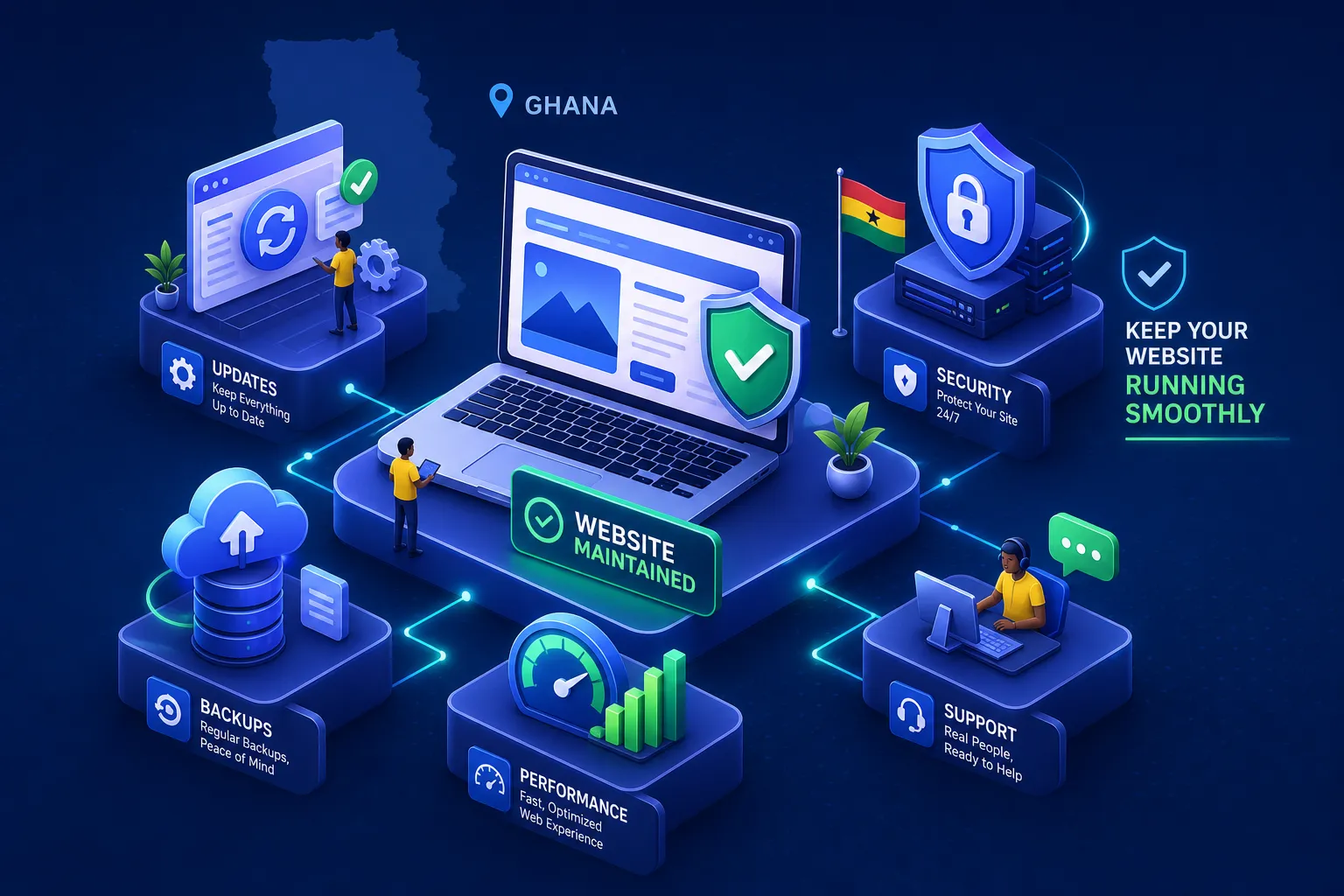

In our experience at Stayplain Studio, many Ghanaian business owners choose website maintenance packages available from Ghanaian providers based on price alone, then discover their site was hacked, went down for three hours on a busy Monday, or quietly dropped off Google because the "maintenance" only meant someone ran a plugin update once a week. That is a costly lesson to learn after the fact.
We have built, secured, and managed websites for businesses across Kumasi, Accra, Tamale, and beyond, you can browse our portfolio to see the range. We see this pattern often enough that it is worth writing plainly about it. This article breaks down what website maintenance packages available from Ghanaian providers actually include, what the common pricing tiers look like in GHS, which features cheap plans quietly skip, and how to compare options by real value before you commit.
Quick Answer: Website maintenance packages are ongoing service plans that keep a business website secure, updated, and performing well. They typically include backups, software updates, security scans, and uptime monitoring. Ghanaian providers generally offer three tiers: basic plans from roughly GHS 300, 750/month; standard plans from GHS 750, 2,000/month; and premium plans from GHS 2,000, 5,000+/month. Each tier carries significantly different scope and service-level commitments, these are market estimates based on available local pricing data.
What website maintenance actually covers (and what it doesn't)
Most people think maintenance means "keeping the lights on." That is only part of it. A proper website maintenance plan covers the full ecosystem of your site: software health, security posture, performance, and content freshness. Not just uptime.
At Stayplain Studio, we think about maintenance through four pillars. Understanding these helps you read any provider's scope document with sharper eyes.
The four pillars of a solid maintenance plan
- Security and integrity: malware scans, SSL certificate management, firewall configuration, and vulnerability patching. This is what stops your site from being hijacked or blacklisted by Google.
- Performance and availability: uptime monitoring, page speed checks, Core Web Vitals tracking, and server health. A slow site is nearly as damaging as one that is down.
- Software hygiene: CMS updates, plugin updates, theme updates, and testing before anything goes live. Running outdated plugins is one of the most common entry points for hackers.
- Content and SEO health: copy edits, broken link checks, crawl error resolution, and search performance monitoring. This is what most budget plans in Ghana skip entirely.
Many cheap Ghanaian maintenance plans only touch the first two pillars. They keep the site technically alive but ignore whether it is ranking, converting, or staying commercially relevant.
Why "it's running fine" is not the same as "it's working"
A site can be technically live while silently losing ground on Google. Crawl errors build up. Page speed degrades. Rankings slip. The business owner receives a monthly report saying "all systems normal" while their traffic graph points steadily downward.
Maintenance without SEO oversight is like servicing a car but never checking whether it is heading in the right direction. The engine runs; you are just not going anywhere useful. The best website maintenance plans that Ghanaian providers offer should address both technical health and commercial performance as a single coherent service.
What website maintenance packages available from Ghanaian providers typically include at each tier
Not all website care packages are built the same. Ghanaian providers generally structure their offerings into three recognisable tiers, even if they use different names for them. Ghana Web Designs is one of the few local providers that publicly lists pricing, with website maintenance plans starting at GHS 300/month. The tiers below reflect the broader market pattern based on available pricing data and are best treated as indicative ranges.
Basic plans (roughly GHS 300, 750/month)
Basic plans cover the essentials: weekly backups, basic uptime monitoring, periodic security scans, and core software updates. What is not covered matters just as much: malware removal if something goes wrong, content edits, SEO health checks, or any meaningful emergency response are typically excluded.
These plans suit low-traffic brochure sites that do not depend on the web for revenue. If your website is a static "about us" page that rarely changes and generates neither leads nor sales, a basic plan may be sufficient. For anyone else, it is a false economy.
Standard plans (roughly GHS 750, 2,000/month)
Standard plans add daily backups, regular security vulnerability checks, same-day or next-day support, and a limited allowance for content updates each month. Support response improves significantly at this tier, typically from a 24, 48-hour window down to same day for urgent issues.
This tier suits SMEs, service businesses, and lead-generating websites. If your site works as a sales tool, this is the minimum tier worth considering. Even a modest content update allowance means you are not paying an hourly rate every time you need to change a price or add a new service.
Premium plans (roughly GHS 2,000, 5,000+/month)
Premium managed website services in Ghana typically include real-time monitoring, prompt malware removal, 24/7 support, faster SLA response (within 1, 4 hours for critical issues), SEO health reporting, and ongoing performance optimisation. This tier is built for sites where downtime directly means lost revenue.
E-commerce sites, high-traffic platforms, membership portals, and any business generating significant revenue through its website belong here. The cost reflects both the scope of services and the speed of response when something goes wrong at 2am on a Saturday.
Core features every plan should include regardless of price
Before you compare prices, establish your baseline. Certain features are non-negotiable. They are the minimum a reputable provider should include at any tier, and you should walk away from any contract that leaves them out.
Security scans, SSL management, and malware removal
Periodic scanning means the provider checks your site on a schedule, perhaps weekly or monthly. Real-time scanning means threats are detected as they happen. The difference matters enormously for sites that attract regular traffic or handle customer data.
Malware removal is where many basic plans reveal their limits. They scan for malware but exclude the actual removal from the contract scope, billing it separately per incident. Our WordPress malware removal service has handled infected sites presenting deceptive-site warnings and spam redirect issues flagged by Google, the kind of incidents a proper maintenance plan prevents before they occur. If your plan does not include remediation as well as detection, it is incomplete.
SSL certificate renewals should also be handled by your provider, not left to expire because nobody was watching the renewal date. An expired SSL certificate displays a security warning to every visitor, damages user trust, and, according to Google's own guidance, can negatively affect your search visibility.
Automated backups and reliable restore points
Daily backups stored off-site, away from the same server as your live website, are the recommended best practice for most businesses. Before you sign anything, ask specifically: how many restore points are kept, how long a full restore takes, and whether restores are included in the contract or billed separately.
Some providers offer "backups" that turn out to be weekly snapshots stored on the same server as the live site. If the server goes down, the backup goes with it. Push for clarity on this before you commit.
Software and plugin updates with testing
Updates without testing on a staging environment can break a live site. A plugin update that conflicts with your theme can take your homepage offline within minutes of being applied. A responsible provider tests updates on a staging copy of your site before pushing anything live.
Ask this question directly: do you test updates on a staging environment before deploying to the live site? If the provider cannot answer clearly, or if the answer is no, that is a significant red flag regardless of the price they are quoting.
What cheaper maintenance plans quietly leave out
This is where most Ghanaian business owners get stung. A GHS 300/month plan looks attractive on the surface until you understand what it does not include.
SEO health checks and search performance monitoring
The overwhelming majority of budget website maintenance plans in Ghana do not include any form of SEO monitoring. A site can remain technically live while silently losing rankings due to crawl errors, slow page speed, broken internal links, or thin content accumulating over months.
Our approach at Stayplain Studio bundles ongoing SEO performance monitoring alongside technical upkeep, so managed sites stay visible and converting, not just online. Our SEO services in Ghana work directly alongside site management rather than being treated as a separate, disconnected service. Maintenance without SEO oversight is incomplete. You are keeping the machine running without measuring whether it is producing anything.
Content updates and conversion support
Many plans cap content edits at zero, or at one to two minor changes per month. For businesses that regularly update service offerings, adjust pricing, run promotions, or publish new portfolio work, this gap adds up fast. Every change outside the contracted scope means an hourly rate on top of your monthly fee.
Ask specifically: how many content update requests are included each month, what counts as a "minor" edit, and what the guaranteed turnaround is for those requests. Vague answers here usually mean a frustrating billing dispute later.
Extra charges Ghanaian providers don't always advertise upfront
The monthly fee is only part of the total cost. Several common extras can push the real figure well above what was quoted in the proposal.
E-commerce and high-traffic site premiums
E-commerce sites typically attract add-on charges for payment gateway maintenance, inventory system support, and the stronger security configurations that transactional sites require. These are legitimate costs, but they should be disclosed before you sign, not discovered when the first invoice arrives.
High-traffic sites also require higher-capacity hosting. One Ghanaian pricing guide estimates hosting costs alone at GHS 200, 2,000 yearly based on traffic volume, and that figure sits outside most standard maintenance contracts. If you run an online store or a high-traffic platform, ask directly whether hosting upgrades are bundled into the maintenance fee or billed separately.
Emergency fixes, rush work, and incident response
Unplanned work is expensive. Ghanaian providers that do not include emergency response in their SLA commonly charge a 20, 40% premium for urgent fixes, on top of their standard hourly rate. Plugin licence renewals, stock image refreshes, premium API integrations, and Google Search Console issue resolution are also frequently billed as extras.
The fix is straightforward: ask for a written list of what triggers an out-of-scope charge before you sign anything. A provider that cannot or will not produce this list is one you should think carefully about trusting with your website.
SLA terms and contract clauses to read before you sign
A website care package in Ghana is only as reliable as the contract backing it. Response time commitments mean nothing if they are not written into the agreement with clear remedies attached.
Response time tiers and what they mean in practice
A standard SLA structure looks like this: emergency faults resolved within 4 hours, urgent issues by the next working day, and routine requests within 5 working days. For premium plans with 24/7 support, critical response windows are typically 1, 4 hours, sometimes faster.
Before you sign, ask two questions. First: who classifies the fault as emergency versus routine? If it is solely the provider's discretion, a "critical" issue can easily be downgraded to save them the response time commitment. Second: what is the remedy if the provider misses the SLA window? If the answer is nothing, the SLA is decorative. Uptime guarantees should also be expressed as a percentage, for example, 99.5% monthly uptime, with a defined credit or service extension for any shortfall.
Minimum contract terms and cancellation rights
Most Ghanaian website maintenance contracts run on a monthly or annual basis. Annual plans typically offer a lower effective monthly rate but lock you in. Monthly contracts cost slightly more but give you an exit if the relationship is not working. If you are evaluating a new provider for the first time, start monthly until you have verified their reliability through direct experience.
Termination provisions commonly require 30, 90 days' written notice to cancel without penalty. Always ask for the cancellation clause in writing before you sign. A provider that resists putting this in writing is telling you something important.
How to compare packages by value, not just price
Two providers can both charge GHS 1,200/month and deliver completely different things. Price is not the comparison point; value per GHS is.
Five questions to ask every provider before committing
Work through these questions with any provider you are seriously considering. The quality of their answers tells you more than any feature checklist.
- Backups and restores: What does your backup and restore process look like exactly, where are backups stored, and how long does a full restore take?
- Support SLA: What is your response time commitment, and what happens if you miss it?
- SEO health monitoring: Is this included in the plan or a separate cost? This distinction separates maintenance plans that protect your investment from ones that simply keep your server lights on.
- Out-of-scope charges: What specifically triggers an additional charge? Ask them to be precise.
- Performance evidence: Can you show examples of sites you currently manage along with performance data, not just design screenshots?
A provider with nothing to show on the performance side may not be tracking it at all.
The value signals that separate serious providers from the rest
Transparent pricing published openly on their website is a good sign. A written scope document, not just a verbal summary, is non-negotiable. Demonstrated SEO or security outcomes for existing clients, not just aesthetic work, shows that the provider thinks about your site's commercial performance rather than just its appearance.
At Stayplain Studio, our case studies document measurable outcomes across both security remediation and SEO growth for clients in Ghana and internationally, including raising Chloe International's domain authority from DA 7 to DA 50+ over three months and resolving Google indexing issues for multiple Ghanaian NGOs and businesses. That kind of evidence is what you should be asking every provider to show you.
What to look for in a long-term website maintenance partner in Ghana
A maintenance provider is not a one-time vendor. You are entering an ongoing relationship that directly affects whether your site keeps finding and converting customers.
Why maintenance and SEO monitoring belong together
Consider what silent ranking loss actually looks like for a Ghanaian SME: traffic drops gradually over two or three months, enquiries thin out, and by the time the business owner notices, a competitor has taken the positions that took months to build. A site can be technically healthy but commercially invisible if no one is watching its search performance.
Providers worth paying for treat maintenance as part of a broader growth system: uptime and security keep the site alive; SEO monitoring keeps it finding new customers. At Stayplain Studio, we bundle website maintenance with ongoing SEO performance tracking as part of our managed website services. Clients are not paying twice for what should be one coherent service. Our website design services in Ghana page covers our full scope, from initial builds to ongoing managed support, and you can also review our portfolio to see the range of businesses we currently support.
Comparing website maintenance packages available from Ghanaian providers: a practical shortlist by business size
For small businesses operating on a tight budget, the non-negotiables are: daily backups stored off-site, real malware removal (not just detection), SSL management, and uptime monitoring with alerts. These four things alone separate a functional maintenance plan from a false sense of security.
Growing businesses and e-commerce sites should add SEO health checks, content update credits, and a clear emergency response SLA with a written remedy for missed windows. These are not premium additions; they are the baseline for any site that generates revenue. If your site upkeep service in Ghana does not cover these, you are underprotected at the price point that matters most.
High-traffic or revenue-critical platforms warrant a premium or custom plan: real-time monitoring, guaranteed sub-four-hour response for critical issues, staging environment testing for all updates, and monthly performance reporting. The cost is real, but so is the cost of going offline during your busiest trading period.
Choose your maintenance plan on scope, not price
Website maintenance packages available from Ghanaian providers vary enormously in what they actually cover. The monthly price tells you almost nothing without reading the scope document carefully. Two plans at identical prices can carry completely different security postures, backup strategies, support commitments, and levels of SEO oversight.
The non-negotiables remain consistent: daily off-site backups, malware scanning and removal, SSL management, uptime monitoring, and tested software updates. Beyond that, everything scales with how much your business depends on its website. If your site generates revenue, the SEO health monitoring and emergency response SLA are not luxuries, they are the whole point of site maintenance pricing in Ghana.
Ask hard questions before you sign. Get the scope document and the cancellation clause in writing. And if you want a partner who treats maintenance as part of a growth system rather than a monthly checklist, get in touch with our team or request a free website audit to find out exactly where your site stands right now.