

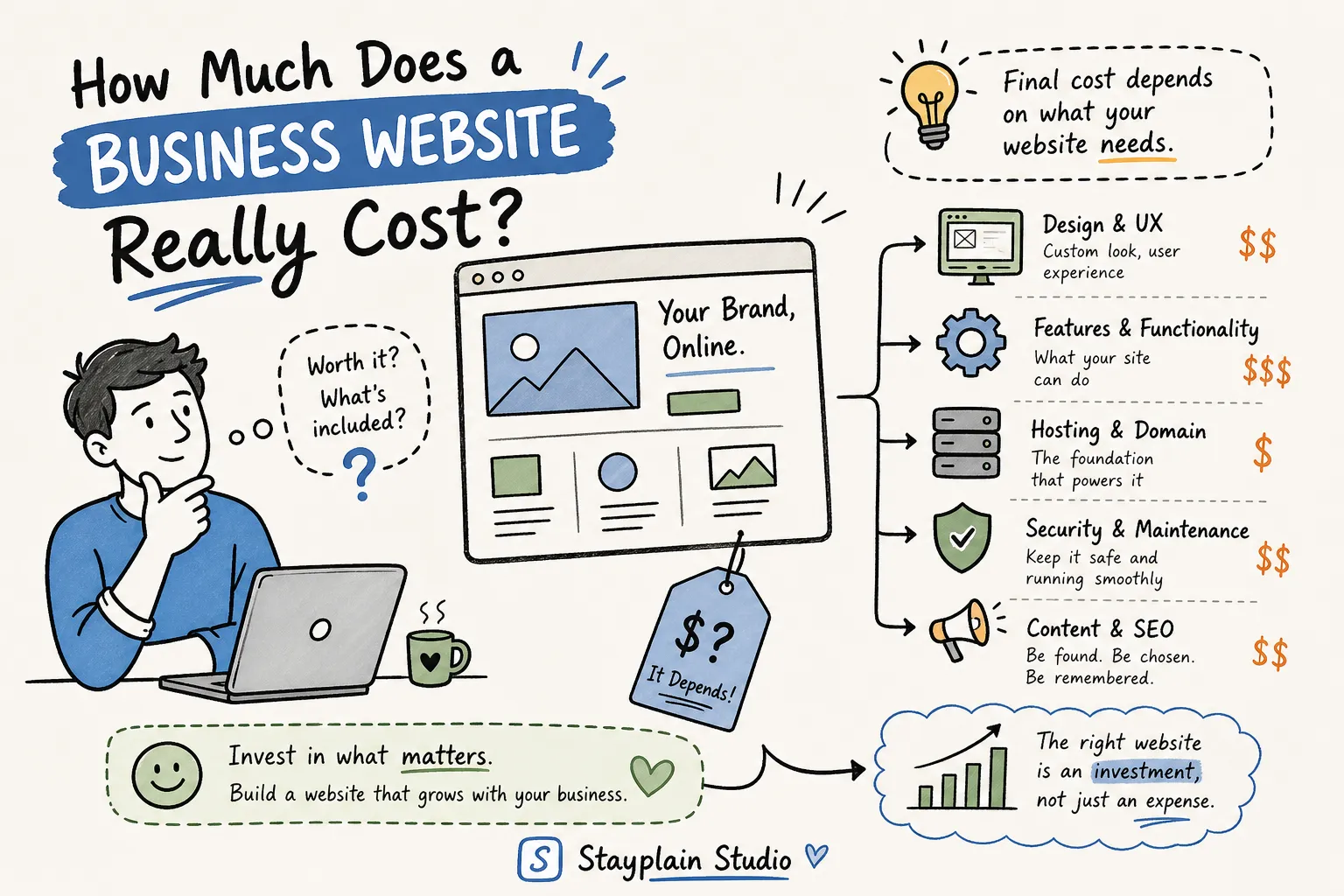

How much does a website cost? It is one of the questions we receive most often at Stayplain Studio, and understanding website pricing starts with one honest admission: there is no single number. Every time someone asks, the answer begins not with a figure, but with a conversation.
The reason nobody gives you a straight answer is not that web designers are being evasive. It is because website pricing genuinely depends on what you need. Think of it like building construction: a two-bedroom house in Kumasi does not cost the same as a five-storey office complex in Accra. The scope, the materials, and the finishing determine the price. Websites are no different. Accurate pricing only makes sense once you understand what is driving the numbers.
Quick Answer: Website pricing in Ghana in 2026 ranges from GHS 990 for a basic brochure site to GHS 50,000+ for a custom-built platform. Most Ghanaian small businesses spend between GHS 1,500 and GHS 8,000 on their initial build. Ongoing annual costs for domain, hosting, and maintenance typically add GHS 800 to GHS 3,000 per year on top of that. These ranges reflect current agency and freelancer quotes in the Ghanaian market, based on 2026 pricing data from local providers.
This article breaks down what you can expect to pay by site type, explains every recurring cost that catches business owners off guard, and gives you a practical checklist for requesting quotes that actually make sense. Whether you are a startup in Accra building your first site or an established business in Kumasi looking to redesign, these figures are for you. For a detailed look at published packages, visit our website design prices in Ghana page, where we lay out exactly what each tier includes.
Why website pricing never gives you a straight answer
A website is not a product with a fixed shelf price. It is a service shaped entirely by what you need it to do. That is the foundational reason pricing is so variable, and understanding this saves you from comparing quotes that are not even measuring the same thing.
When one business owner says they want a "simple website," they mean five clean pages with a phone number. Another person's "simple website" has 40 pages, a booking system, a client portal, and a mobile app integration. The price gap between those two is not a rounding error. It is potentially GHS 20,000 or more. Your frustration with vague answers is completely valid, but the vagueness reflects how different sites can be, not how evasive agencies are.
Why "it depends" is still the most honest answer
Until you have a clear brief, scope is genuinely unknown. Experienced agencies are not stalling when they ask questions before quoting. They are trying to give you a number that is actually accurate rather than one that looks good on first contact and blows up later. A quote without a scope of work is not a quote, it is a guess. One of the most common problems we see is a client who received a low number upfront, agreed to it without a written scope, and then faced escalating charges as requirements were added mid-build. Getting scope right from the start is what protects both sides.
What every web design quote comes down to
Every website budget ultimately comes down to what you need, what it takes to build it, and who you trust to do the work. Get clarity on those three points, and every quote you receive starts to make more sense.
The four website types and what each costs in Ghana
Ghana's web design market has matured significantly. Below are real 2026 price ranges based on what agencies and freelancers are actually quoting. Use these as baselines, not guarantees, since scope always has the final say on the website development cost.
| Website type | Price range (GHS) | Best for |
|---|---|---|
| Basic brochure site | GHS 990 to GHS 2,000 | Freelancers, local service businesses, startups |
| Small business / corporate site | GHS 1,500 to GHS 5,000 | Ghanaian SMEs, professional service firms |
| eCommerce website | GHS 3,500 to GHS 15,000 | Retail, product-based businesses, online stores |
| Custom build | GHS 7,000 to GHS 50,000+ | Complex platforms, portals, bespoke functionality |
Basic brochure sites: GHS 990 to GHS 2,000
This tier covers sites of one to ten pages, responsive design, a contact form, basic SEO setup, and a standard template. Domain and hosting are often bundled. At GHS 990, you are looking at a five-page site completed in two to three days. At GHS 1,500, expect up to ten pages with slightly more design attention. This is the right starting point for freelancers, local service businesses, and any founder who needs an online presence before the phone number on a flyer.
Small business and corporate sites: GHS 1,500 to GHS 5,000
This is the most common range for Ghanaian SMEs. You get a higher page count, CMS integration (usually WordPress), structured SEO, professional design, and multiple form types. At the upper end of this bracket, expect custom design elements, more complex navigation, and basic third-party integrations. Most businesses find everything they need in this range, it balances affordability with the credibility a professional firm requires.
eCommerce websites: GHS 3,500 to GHS 15,000
Online stores cost more because they require more: a product catalogue, checkout flow, payment gateway integration, inventory management, and a higher standard of security. The build cost reflects technical complexity, not a pricing premium. Payment gateway options commonly recommended for Ghanaian businesses include Paystack, Flutterwave, and Hubtel, though market adoption varies and you should confirm which gateway suits your specific customer base and transaction volume. If your business sells physical or digital products online, this investment is unavoidable. Our eCommerce website design in Ghana service is built specifically for businesses in this category, with payment gateway integration and conversion-focused architecture included.
Custom builds: GHS 7,000 to GHS 50,000+
Custom builds are for situations where templates and off-the-shelf solutions genuinely cannot do what the business needs. Think user account systems, booking engines, client portals, API integrations with CRMs or ERPs, and bespoke dashboards. The price reflects design, development, testing, longer timelines, and ongoing support requirements. These are not vanity projects. They are operational tools, and they are priced accordingly.
The ongoing costs most clients don't budget for
The build cost is only part of the picture. A website has recurring annual and monthly costs that most business owners forget to account for. Plan for these upfront so they do not come as a surprise six months after launch.
Domain registration and annual renewal
A .com domain in Ghana costs roughly GHS 260 to register and GHS 370 to renew annually with local registrars such as HostAfrica. First-year promotional rates are often lower, but renewal pricing is higher, so factor that in. Always confirm that the domain is registered in your business's name, not the agency's. That is your asset, not theirs.
Hosting: shared, VPS, and what the difference costs you
Shared hosting runs GHS 150 to GHS 600 per year for small sites. It is adequate for brochure sites and low-traffic businesses. VPS hosting runs GHS 600 to GHS 3,000+ per year and provides dedicated server resources, better performance under traffic, and more stability. For an eCommerce site or any site where downtime costs you money, shared hosting is a false economy. The upgrade to VPS is usually worth it.
SSL certificates and website security fees
Most reputable hosts now include a free Let's Encrypt SSL certificate as standard, which means this line item is often GHS 0 for basic sites. Some agencies include SSL in their packages. If you need an advanced certificate for a high-transaction eCommerce site, expect to pay GHS 100 to GHS 800 per year for a premium certificate. Ask your agency or host before budgeting this separately.
Website maintenance and support fees
Standard maintenance packages from Ghanaian agencies typically run around GHS 100 per month, or GHS 600 to GHS 1,200 per year for a basic plan. Higher-touch packages that include developer support, frequent content updates, and security monitoring can reach GHS 6,000+ per year. What does maintenance actually cover? Software updates, monthly backups, security and malware scans, uptime monitoring, basic content edits, and monthly reporting. Skipping maintenance to save money is one of the more expensive decisions a business owner can make, the cost of fixing a hacked or broken site is almost always higher than the annual maintenance fee.
At Stayplain Studio, we have scanned and removed malware, cleared Google deception warnings, and resolved spam redirect issues for clients who had previously skipped maintenance entirely. In our experience, emergency remediation consistently costs more than several years of preventive maintenance would have. Budget for maintenance from day one.
How your feature choices push the final price higher
Any agency's initial quote starts with a baseline for your site type. Feature choices are what move that number upward, and this is where most clients get surprised when they see the final figure.
CMS customisation and what it really adds
A standard WordPress setup is relatively affordable and included in most small business packages. Custom CMS work, bespoke admin dashboards, or moving to a headless CMS adds significant development time. If you need editors to manage content easily without touching code, a well-configured standard CMS is usually enough. Consider a client managing 200 product descriptions: they need a CMS configured for bulk editing, a standard out-of-the-box setup will frustrate them within weeks. Only invest in custom CMS development if your content management needs genuinely cannot be met by what is already available.
Payment integration and eCommerce checkout
Payment gateway setup is one of the more expensive features to add post-launch. It requires secure transaction handling, testing across payment methods (card, mobile money, bank transfer), and integration with local providers. Note that payment gateways also charge per-transaction fees on top of the website development cost. Factor their transaction percentages into your business model when you are planning revenue projections.
User accounts, multilingual support, and third-party integrations
User login systems and role-based dashboards add backend logic, security architecture, and data handling requirements that raise both build cost and ongoing maintenance complexity. Multilingual support increases the build cost and adds a permanent content management overhead for every piece of content that needs to be updated in multiple languages. API integrations with booking systems, CRMs, or ERPs are almost always quoted separately because the complexity varies so much from one integration to the next.
DIY, freelancer, or agency: which one fits your situation?
This is the most consequential decision in the whole process. The right answer depends on what you need the site to actually do for your business, not just on budget.
The DIY route: lowest upfront cost, highest time investment
Website builders like Wix and Squarespace cost GHS 200 to GHS 800 in year one. They are a reasonable choice for testing a concept, building a personal portfolio, or a side project with no serious growth ambitions. For a business focused on ranking on Google, however, they may limit your SEO potential relative to a custom or agency-built site, the templates constrain both design flexibility and the technical optimisation that search engines reward. Your hours have a cost too, even if they do not show up on an invoice.
Hiring a freelancer: more control, more risk
Freelancers are cost-effective for straightforward builds and can deliver solid work. The risk is inconsistent quality, limited accountability when things go wrong, and no team available for complex requirements. There is also rarely any ongoing support structure. If you hire a freelancer, get everything in writing: scope, timeline, revision rounds, and what happens post-launch. A verbal agreement is not a contract.
Working with an agency: higher investment, clearer accountability
Agencies offer strategy, design, development, and support under one roof. The higher price reflects the team, the process, and the accountability that comes with a proper business relationship. For businesses serious about growth, converting visitors into paying customers, and ranking on Google, the agency model is where the value starts to show. Our website design services in Ghana are built around exactly this: not just making sites that look good, but building sites that perform.
A realistic 2026 website budget framework for Ghanaian businesses
Use these three budget bands as a planning guide. They include both the build cost and the first-year running costs so you have a complete picture before you start any conversations.
Lean budget: GHS 990 to GHS 2,500
This covers a basic brochure site on a standard template, domain and shared hosting often bundled, a contact form, and minimal design customisation. First-year total cost including domain, hosting, and the build sits at the lower end of this range. What it will not cover: custom design, deep SEO work, eCommerce, or ongoing support. Right for freelancers, side projects, and businesses that just need a credible online presence fast.
Standard budget: GHS 2,500 to GHS 8,000
This range does the most work per cedi for most Ghanaian service businesses and professional firms. You get a professionally designed site of up to 15 to 20 pages, CMS integration, structured SEO, contact and lead capture forms, and usually a basic maintenance package. Annual recurring costs in this band run approximately GHS 800 to GHS 2,000 for hosting, domain renewal, and maintenance. This budget produces a site that works hard, not just one that looks acceptable.
Growth budget: GHS 8,000 to GHS 20,000+
This covers eCommerce stores, businesses targeting international markets, and organisations that need custom functionality built specifically for their operations. You get bespoke design, payment integration, SEO-engineered site architecture, and ongoing support that scales with your business. Our portfolio includes work at this level for clients across Ghana and West Africa, from online retailers to NGOs, health clinics, and solar companies. For proof of what this looks like in practice, our case studies document specific outcomes for clients across different sectors.
How to request a quote and actually understand what you are paying for
Most confusing web design quotes are a symptom of a vague brief. The more clearly you define what you need before making contact, the more accurate and comparable the quotes you receive will be.
What to prepare before you contact anyone
Gather this information before you pick up the phone or send an email:
- The number of pages you need and what each page does
- The primary purpose of the site (generate leads, sell products, provide information)
- Any specific features: booking system, payment gateway, user accounts, product catalogue
- Whether you have existing branding (logo, brand colours, fonts)
- Your target audience and any geographic focus
- Your intended launch date
- Your budget range, even a rough one
An agency can only give you an accurate quote if your brief is clear. Arriving without this information does not get you a better quote. It gets you a guess.
Questions to ask any web design agency
Ask these before you sign anything:
- Is the quote fixed-price or hourly? What triggers additional charges?
- How many design revision rounds are included?
- Who owns the domain, hosting, and source code after launch?
- What is included post-launch? What costs extra?
- What does maintenance cover and what does it cost annually?
- Who does the actual work? Is any of it outsourced?
- Can you share case studies or client references relevant to my industry?
Red flags in a web design quote
Walk away from any agency or freelancer that offers no written scope of work, cannot explain what is included and what is not, has no revision policy, or quotes a price that seems structurally too low to be sustainable. A cheap website that does not convert is not a bargain. It is the most expensive option available, because you will spend money building it and then spend more money fixing or replacing it. A credible agency welcomes informed questions, that is a sign of confidence, not inconvenience.
What transparent, value-driven website pricing looks like in practice
When a web design agency prices honestly, the quote is not a mystery. It is a document that tells you exactly what you are buying, what happens at each stage, and what the site is expected to do for your business once it is live.
Why package pricing beats vague hourly quotes for most businesses
Fixed-scope packages give you predictability. You know what you are spending, what you are getting, and when it will be done. Hourly billing puts the financial risk on the client: if the project takes longer than estimated, your cost increases. For most small and medium businesses, a well-scoped package is the more practical and accountable arrangement.
What a well-structured agency quote actually includes
A properly structured quote covers the discovery process, design rounds with defined revision limits, development phases, browser and device testing, launch support, and clarity on what happens in the first 30 days after the site goes live. At Stayplain Studio, our packages are structured this way from the start. You will find our full breakdown on our website design pricing page, with transparent tiers and no hidden charges. Our work is focused on building sites that rank on Google and convert visitors into paying customers, not just sites that look good in a screenshot.
Getting started without guesswork
If you are not yet sure which tier or type of site fits your business, the most useful first step is a free website audit. It gives you an honest picture of where your current online presence stands and what a realistic path forward looks like. Reach out to us directly via WhatsApp or use the contact form below, and our team will come back to you with a clear, no-obligation assessment.
[wpforms id="42328"]
Wrapping up: website pricing in perspective
Website pricing in Ghana is not complicated once you understand what drives it. Scope determines cost. Features add to scope. Who builds it determines both quality and accountability. And ongoing costs are not optional line items; they are the reality of keeping a working website alive and performing.
The real cost of a poor website is not the invoice you paid. It is the gap between the business you expected and the business you got, visitors who left without converting, and competitors who ranked above you because their site was built to perform. At Stayplain Studio, we build websites engineered for both search visibility and sales conversion. If you want website pricing in Ghana that you can actually trust and plan around, start by telling us what you need. We will do the rest.