

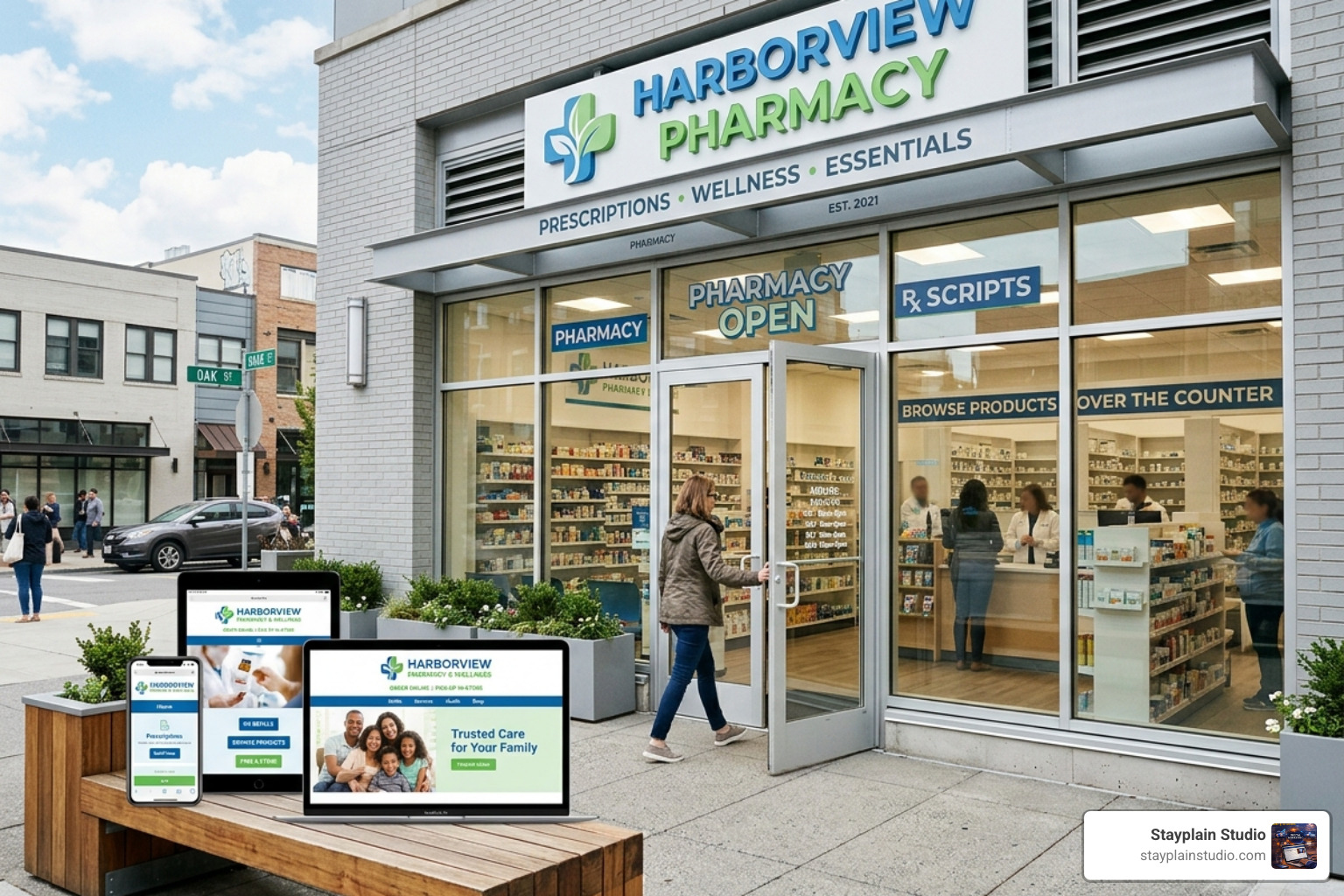

10 Keys to Perfect Responsive Pharmacy Sites
Why Every Pharmacy Needs Responsive Website Design Right Now
Responsive website design pharmacies rely on is no longer optional — it's the difference between patients finding you or finding your competitor.
Here's a quick answer if that's what you need:
What is responsive website design for pharmacies? Responsive design means your pharmacy website automatically adjusts its layout, images, and text to look and work perfectly on any device — phone, tablet, or desktop. For pharmacies, this means patients can refill prescriptions, book appointments, and find your location without pinching, zooming, or getting frustrated.
Why does it matter for pharmacies specifically?
- The majority of pharmacy website traffic now comes from mobile devices
- Google ranks mobile-friendly sites higher in search results (mobile-first indexing)
- You have roughly 3 seconds to capture a visitor's attention before they leave
- 94% of patients are more likely to choose a provider that offers online booking
- 72% of patients who did a local search visited a business within five miles
Think about the last time a patient searched "pharmacy near me" while sitting in a doctor's waiting room. They pulled out their phone. They clicked a result. If your site loaded slowly or looked broken on mobile, they clicked back and chose someone else.
That's the real cost of ignoring responsive design.
At Stayplain Studio, we've seen this play out with healthcare clients like Health Haus Holistic — where a properly built, mobile-optimized site directly translated into more patient inquiries and better local visibility. Our work across healthcare, NGOs, and SMEs consistently shows the same pattern: a fast, responsive site converts; a broken one repels.
If you're looking for professional website development services built specifically for health and pharmacy businesses, you're in the right place.
This guide walks you through the 10 keys to building a responsive pharmacy website that earns patient trust, ranks on Google, and actually drives growth.
Responsive website design pharmacies terms to remember:
Why Responsive Website Design Pharmacies Need is Non-Negotiable
We live in a world where convenience is the primary currency of healthcare. Research shows that search queries are now conducted on mobile devices more often than not. This shift has led search engines to give greater preference to websites that offer a seamless mobile experience. For a local pharmacy, this means your digital storefront must be as accessible as your physical one.
When we talk about responsive website design pharmacies need, we are talking about a strategy that eliminates the "pinch-and-zoom" struggle. If a patient is trying to find your opening hours while standing in a crowded doctor’s office, they shouldn't have to fight your website to find that information. A responsive site ensures cross-device consistency, meaning the branding, functionality, and ease of use remain the same whether they are on a laptop at home or a smartphone on a bus.
Furthermore, Google’s mobile-first indexing means the search engine primarily uses the mobile version of your content for indexing and ranking. If your mobile site is a stripped-down, poorly functioning version of your desktop site, your rankings will suffer. By investing in responsive website design services, you are essentially telling Google that your pharmacy is modern, reliable, and ready to serve patients on their terms. This directly reduces bounce rates — the percentage of people who leave your site after viewing only one page — and keeps potential customers engaged with your services.
Optimizing User Experience for Mobile Pharmacy Customers
User experience (UX) is the heartbeat of any successful digital platform. For pharmacies, UX must prioritize speed and simplicity. We implement "thumb-friendly" navigation, ensuring that buttons for "Refill Prescription" or "Call Now" are within easy reach of a user's thumb. This is part of our broader website design for pharmacies strategy, where we focus on creating intuitive paths for the patient.
Key elements of mobile UX for pharmacies include:
- Touch Targets: Buttons should be at least 44x44 pixels to prevent accidental clicks.
- Font Legibility: No one should need a magnifying glass to read dosage instructions or health advice on your site.
- Fluid Grids and Flexible Images: These technical components allow your site to scale up or down smoothly without breaking the layout.
The Impact of Load Speed on Patient Retention
You have exactly three seconds. That is the average attention span of a visitor on your pharmacy's home page before they decide to stay or move to the next search result. If your site takes five seconds to load because of unoptimized images or heavy code, you’ve already lost the patient.
We focus on "Core Web Vitals," which are specific factors that Google considers important in a webpage's overall user experience. This includes minifying code, leveraging browser caching, and optimizing images so they load instantly. A fast-loading site isn't just a "nice-to-have"; it’s a critical component of responsive website design pharmacies use to maintain high retention rates.
Essential Features for High-Converting Pharmacy Portals
A pretty website is useless if it doesn't perform the tasks your patients need. High-converting pharmacy portals go beyond just displaying an address; they act as a 24/7 extension of your pharmacy staff. Integrating features like online prescription refills and appointment scheduling can transform your business. In fact, 67% of patients now prefer scheduling medical appointments online, and 94% are more likely to choose a provider that offers this convenience.
| Feature | Template-Based | Custom Functionality (Stayplain Studio) |
|---|---|---|
| Prescription Refills | Basic form | Real-time PMS Integration |
| Security | Standard SSL | HIPAA-Compliant Encryption |
| Speed | Varies by host | Optimized for <3s load="load" time="time"> |
| SEO | Generic | Local & Clinical SEO specialized |
| Scalability | Limited | Grows with your business |
By offering these digital conveniences, independent pharmacies can effectively compete with larger national chains. It’s about providing that personalized, community-focused service through a modern interface.
Integrating Secure Prescription Management
Security is the cornerstone of healthcare. When patients submit sensitive data online, they need to know it is protected. We ensure that every secure hospital website design we build incorporates HIPAA-compliant forms and end-to-end encryption for Protected Health Information (PHI).
A truly effective responsive website design pharmacies use will sync directly with their Pharmacy Management System (PMS). This allows for:
- Real-time inventory updates: Patients know if a medication is in stock.
- Automated notifications: SMS or email alerts when a prescription is ready for pickup.
- Secure Patient Portals: A private area where patients can view their medication history.
Leveraging Content for SEO and Patient Authority
Content is still king. To rank well, your pharmacy website needs clinical depth. We recommend condition guides that are 400-700 words long, covering common health issues, treatments, and procedures. This establishes you as an authority in the eyes of both patients and search engines.
As professional website designers in ghana, we also emphasize local SEO. This involves optimizing your site for phrases like "pharmacy in Kumasi" or "prescription delivery in Accra." By combining staff biographies (which build trust) with high-quality health blogs, you create a digital ecosystem that attracts new patients and keeps current ones coming back for advice.

Compliance and Security Standards for Modern Pharmacies
Building a pharmacy website involves navigating a complex web of regulations. Beyond HIPAA, your site must meet ADA (Americans with Disabilities Act) and WCAG 2.1 AA accessibility standards. This ensures that everyone, including those with visual or hearing impairments, can use your site effectively.
Our custom website design services include:
- SSL Certificates: To encrypt data between the user and the server.
- PCI-DSS Compliance: Essential if you are processing payments for over-the-counter products or delivery fees.
- Regular Security Audits: To protect against malware and data breaches.
At Stayplain Studio, we have a proven track record of fixing security issues. For example, we helped clients like SHEEPLBG and Chloe International remove malware and fix Google Search Console indexing issues, ensuring their sites remained safe and visible.
Accessibility Best Practices for Aging Populations
Pharmacies often serve an older demographic who may struggle with small text or low-contrast designs. To make your site accessible, we use:
- High Contrast Ratios: Making text easy to read against the background.
- Generous Typography: Using clear, sans-serif fonts at readable sizes.
- Keyboard Navigation: Allowing users to navigate the site without a mouse.
- Clear CTAs: Using bold, descriptive buttons like "Order My Refill" instead of generic "Click Here" links.
This attention to detail is what makes our clinic hospital website services stand out in the Ghanaian and global markets.
Choosing the Best Responsive Website Design Pharmacies Framework
The engine under the hood of your website matters. Currently, 43% of all websites are built on WordPress, making it the most trusted Content Management System (CMS) in the world. It’s flexible, SEO-friendly, and easy for pharmacy staff to update without needing to know a single line of code.
As a leading website development company in ghana, we often recommend WordPress for its scalability. However, for pharmacies that need highly specific, high-performance animations or unique layouts, frameworks like Webflow or custom-coded solutions are also excellent options. The goal is to choose a framework that allows for easy maintenance while providing the security and speed a pharmacy requires.
Custom Development vs Template-Based Solutions
While templates can be a quick way to get online, they often come with "bloated" code that slows down your site and limits your SEO potential. Custom development, on the other hand, allows us to build a site tailored exactly to your pharmacy’s workflow.
Benefits of custom professional website development services include:
- Unique Brand Identity: You won't look like every other pharmacy using the same $50 template.
- Better Long-Term ROI: Custom sites are easier to scale as your business grows.
- Technical Debt Reduction: Clean code means fewer bugs and faster load times.
Our portfolio showcases how we’ve helped businesses move from "invisible" to "industry leaders" through custom digital solutions.
Measuring Success and Planning Your Redesign Cycle
A website is not a "set it and forget it" project. The average lifespan of a website is approximately 2-3 years. After this period, code becomes outdated, security vulnerabilities can emerge, and design trends shift. If your site is older than three years, it is likely negatively impacting your search engine rankings and patient trust.
We recommend regular website redesign services to keep your digital presence fresh. By using tools like user behavior heatmaps and A/B testing, we can see exactly where patients are clicking and where they are getting frustrated, allowing us to make data-driven improvements.
Key Metrics for Pharmacy Website Growth
To know if your responsive website design pharmacies investment is working, you need to track the right data. We help our clients monitor:
- Online Refill Adoption: How many patients are moving from phone calls to digital refills?
- Local Search Rankings: Are you appearing in the "Map Pack" for local pharmacy searches?
- Patient Inquiry Rates: How many people are using your contact forms or "Call Now" buttons?
By focusing on these metrics, we ensure that your site is a growth engine, not just a digital brochure. As the best website design company in ghana, our focus is always on your bottom line.

Frequently Asked Questions about Pharmacy Web Design
How does responsive design help pharmacies compete with large chains?
Responsive design levels the playing field. It allows independent pharmacies to offer the same mobile conveniences — like easy refills and appointment booking — that patients expect from big chains. When you combine these digital tools with your superior, personalized local service, you create a winning combination that chains can't match.
What are the mandatory compliance requirements for pharmacy sites?
At a minimum, pharmacy sites must be HIPAA-compliant if they handle patient data. They should also follow ADA/WCAG guidelines for accessibility and PCI-DSS standards for secure payments. Including a Notice of Privacy Practices (NPP) in the footer is also a legal requirement for most healthcare providers.
How often should a pharmacy website be updated or redesigned?
Technology moves fast. We recommend a full redesign every 2-3 years to ensure your site remains secure, fast, and compatible with the latest mobile devices. However, content and security patches should be updated weekly or monthly.
Conclusion
The digital health landscape is changing, and your pharmacy needs to be ready. A responsive website design pharmacies can trust is one that prioritizes the patient, respects security, and drives business growth. From our offices in Kumasi and Accra to our global clients in the USA and India, Stayplain Studio is dedicated to building these high-performance systems.
We’ve helped organizations like Health Haus Holistic and the Limitless Hope Foundation transform their online presence. Whether you need to fix a "Deception" warning on Google or build a brand-new, SEO-optimized pharmacy portal, our team has the expertise to deliver.
[wpforms id="42328"]
For expert assistance in building your digital presence, partner with the best website design company in ghana to ensure your pharmacy stays ahead of the competition. Explore our website design services in Ghana.