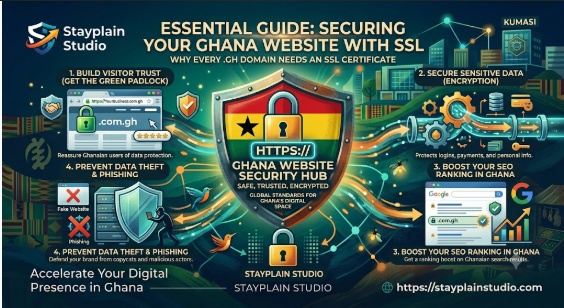
SSL Certificate Ghana Website Owners Need: What It Is and Why It's Non-Negotiable
An SSL certificate Ghana website owners need is a small security file that encrypts data traveling between your website and its visitors, shown to customers as the padlock icon and "https://" in the browser address bar. Without one, browsers actively warn visitors that your site is "Not Secure," Google ranks you lower, and any data submitted through your site — including customer names, phone numbers, and payment details — travels unencrypted and vulnerable to interception.
If you run a business website in Ghana and you're still seeing "Not Secure" next to your domain name, you're losing customer trust every single time someone visits. An
SSL certificate used to be something only banks and e-commerce giants worried about — today, it's a baseline requirement for any business website in Kumasi, Accra, Takoradi, or Tamale that wants to be taken seriously by both customers and Google. This guide explains exactly what an SSL certificate is, why it matters for Ghanaian businesses specifically, and how to get one installed correctly. For businesses that want this handled without the technical hassle,
Stayplain Studio includes
SSL setup as a standard part of every website it builds.
Quick Answer: What You Need to Know About SSL in Ghana
Here's the short version before the full breakdown:
- What it does — encrypts data between your website and visitors using HTTPS encryption
- Why you need it — browsers flag sites without it as "Not Secure," damaging trust instantly
- Google ranking impact — SSL is a confirmed Google ranking factor, giving secure sites an SEO edge
- Cost in Ghana — many hosting providers now include free SSL certificates (Let's Encrypt); premium options cost GHS 200–2,000/year
- Who needs it most — any site with a contact form, login, or online payment integration
- Installation time — typically 10–30 minutes for a basic certificate through most hosting control panels
| SSL Certificate Type |
Typical Cost (GHS/year) |
Best For |
| Free SSL (Let's Encrypt) |
0 |
Small business and personal websites |
| Domain Validated (DV) SSL |
200 – 800 |
Standard business websites |
| Organization Validated (OV) SSL |
800 – 2,000 |
Businesses wanting extra verification trust signals |
| Extended Validation (EV) SSL |
2,000 – 6,000+ |
Banks, large e-commerce, high-trust financial sites |
| Wildcard SSL |
1,500 – 4,000 |
Businesses with multiple subdomains |
Why SSL Certificates Matter So Much for Ghana Businesses
Understanding why an
SSL certificate is essential goes beyond a technical checkbox — it directly affects trust, visibility, and legal responsibility for Ghanaian businesses online.
Google Actively Penalizes Unsecured Websites
Google has confirmed that
HTTPS (the secure version of a website address, enabled by SSL) is a ranking signal in its search algorithm, meaning an unsecured website is at a genuine disadvantage in search results compared to competitors using SSL — a disadvantage that compounds as more of Ghana's businesses adopt it.
Mobile Money and Online Payments Demand Trust
As more Ghanaian businesses accept
Mobile Money, Paystack, and card payments directly on their websites, an SSL certificate becomes essential rather than optional — customers are understandably hesitant to enter payment or personal details on a site flagged as insecure by their own browser.
Data Protection Compliance
Under Ghana's Data Protection Act, 2012 (Act 843), businesses collecting personal data through their websites have a responsibility under the Data Protection Commission to implement reasonable technical safeguards. Encrypting data in transit via SSL is one of the most basic, expected safeguards a business can put in place.
Customer Trust Is Fragile Online
In a market where trust and reputation spread heavily through word-of-mouth and social proof, a visible "Not Secure" browser warning can quietly push potential customers toward a competitor's site before they even read your content — often without the business owner realizing it's happening at all.
What Is an SSL Certificate? Key Terms Explained
SSL (Secure Sockets Layer) — now technically succeeded by
TLS (Transport Layer Security), though "SSL" remains the common industry term — is a security protocol that creates an encrypted connection between a web server and a visitor's browser. A few related terms worth understanding:
- HTTPS: The secure version of HTTP (HyperText Transfer Protocol), the system browsers use to load websites. The "S" indicates SSL/TLS encryption is active.
- Certificate Authority (CA): An organization that issues and verifies SSL certificates, confirming that a website legitimately belongs to the business it claims to represent.
- Encryption: The process of scrambling data so that only the intended recipient (the correct server) can read it, protecting it from interception during transmission.
- Mixed content warning: An error that appears when a secure (HTTPS) page still loads some resources over an insecure (HTTP) connection, which can partially undermine SSL protection if not fixed.
Types of SSL Certificates Available for Ghana Websites
1. Domain Validated (DV) SSL
The most common and affordable option, DV SSL simply verifies that the applicant controls the domain in question. It's suitable for the majority of small and medium business websites in Ghana that don't process high volumes of sensitive financial data directly.
2. Organization Validated (OV) SSL
OV SSL includes additional verification of the business itself, not just domain ownership, offering a slightly stronger trust signal — useful for businesses wanting to reassure customers beyond the basic padlock icon.
3. Extended Validation (EV) SSL
EV SSL involves the most rigorous verification process and is typically reserved for banks, large financial institutions, and major e-commerce platforms where the highest level of visible trust assurance is warranted.
4. Wildcard SSL
For businesses running multiple subdomains (such as shop.example.com and blog.example.com), a
wildcard certificate covers all subdomains under a single certificate, simplifying management compared to purchasing separate certificates for each.
5. Free SSL (Let's Encrypt)
Many hosting providers serving the Ghanaian market now offer free SSL certificates through Let's Encrypt, a nonprofit certificate authority. For most small business websites, this free option provides the same core encryption protection as a paid certificate.
Real Ghana Business Examples: The Impact of SSL
- A fashion retailer in Kumasi running an online store saw a noticeable increase in completed checkouts after installing an SSL certificate, since customers had previously abandoned the payment page upon seeing their browser's "Not Secure" warning.
- A consulting firm in Accra discovered their website was still loading over HTTP despite having purchased an SSL certificate months earlier — a common misconfiguration where the certificate exists but hasn't been properly enforced site-wide. Fixing the HTTPS redirect resolved the issue and removed the browser warning entirely.
- A logistics company in Takoradi with a quote-request form on their homepage had prospective clients hesitant to submit contact information without visible security assurance. Adding SSL alongside a clear security badge noticeably increased form completions.
- An NGO in Tamale collecting donations through an online donor portal needed SSL not just for trust, but to meet basic expectations from international donor organizations that routinely check for HTTPS before contributing through any website.
Step-by-Step Guide: How to Install and Verify SSL on Your Website
Follow this process to get SSL properly set up and functioning across your entire website.
- Step 1: Check if your hosting provider offers free SSL. Most modern hosting providers include free Let's Encrypt SSL certificates, activatable directly from your hosting control panel (cPanel or similar).
- Step 2: Choose a certificate type based on your needs. A standard DV SSL is sufficient for most business websites; only consider OV or EV if your business specifically requires elevated trust verification.
- Step 3: Install the certificate through your hosting panel. Most hosts provide a one-click SSL activation tool, though some configurations may require manual setup with your web developer's help.
- Step 4: Force HTTPS site-wide. Configure your website so all traffic automatically redirects from HTTP to HTTPS, ensuring no page loads insecurely even if someone types the old address.
- Step 5: Fix any mixed content warnings. Check that all images, scripts, and embedded resources load over HTTPS as well, since insecure resources on an otherwise secure page can still trigger browser warnings.
- Step 6: Verify the padlock icon appears correctly. Visit your website in a browser and confirm the padlock icon shows without any warning symbols, confirming SSL is functioning correctly across the site.
- Step 7: Set a renewal reminder. Free SSL certificates typically renew automatically, but paid certificates may require manual renewal — missing a renewal deadline can suddenly expose your site to security warnings again.
- Step 8: Get professional help for e-commerce or complex sites. Businesses running online stores or multiple subdomains benefit from professional SSL configuration to avoid gaps — a service included as standard in Stayplain Studio's website design and maintenance packages.
Common SSL Mistakes Ghanaian Businesses Make
- Assuming a purchased certificate is automatically active without verifying HTTPS is enforced site-wide
- Ignoring mixed content warnings, which can undermine an otherwise properly installed certificate
- Letting a paid certificate expire without a renewal reminder in place
- Choosing an unnecessarily expensive EV certificate when a free or basic DV certificate would suffice for a small business site
- Not redirecting old HTTP links after switching to HTTPS, creating broken links from external sources
- Treating SSL as a one-time task rather than confirming it periodically, especially after site migrations or redesigns
Frequently Asked Questions
- Do I really need an SSL certificate for my business website in Ghana? Yes. An SSL certificate is essential for any business website in Ghana, since browsers actively flag sites without one as "Not Secure," which damages visitor trust and puts you at a disadvantage in Google search rankings.
- How much does an SSL certificate cost in Ghana? Many hosting providers now include free SSL certificates through Let's Encrypt, while premium certificate options range from roughly GHS 200 to GHS 6,000+ per year depending on the verification level chosen.
- What happens if my website doesn't have an SSL certificate? Without SSL, browsers display a "Not Secure" warning to visitors, data submitted through forms or payments travels unencrypted, and Google ranks the site lower than SSL-secured competitors in search results.
- Is free SSL (Let's Encrypt) as secure as a paid SSL certificate? Yes, in terms of core encryption strength, free SSL certificates from Let's Encrypt provide the same fundamental protection as paid certificates; the main difference in paid options is the level of business identity verification displayed, not the encryption itself.
- How long does it take to install an SSL certificate on a Ghana-hosted website? For most websites, activating a free or basic SSL certificate through a hosting control panel takes 10–30 minutes, though ensuring it's correctly enforced site-wide and free of mixed content warnings may require additional configuration.
- Can SSL certificates expire, and what happens if mine does? Yes, SSL certificates have expiration dates, and an expired certificate causes browsers to show security warnings again, immediately undermining visitor trust until it's renewed.
- Does SSL protect my website from being hacked? No. SSL encrypts data in transit between your website and visitors, but it doesn't protect against malware, weak passwords, or outdated software vulnerabilities, which require separate security measures alongside SSL.
- Does Stayplain Studio include SSL setup when building a website in Ghana? Yes. Stayplain Studio installs and properly configures SSL certificates as a standard part of every website it builds and manages for businesses across Kumasi, Accra, Takoradi, Tamale, and beyond.
Secure Your Website With Proper SSL Before It Costs You Customers
An
SSL certificate is one of the simplest, most foundational website security tips a Ghanaian business can implement — yet it's still overlooked by businesses in Kumasi, Accra, Takoradi, and Tamale that assume their site is "fine" without checking. If your website still shows a "Not Secure" warning, every visitor sees it before they see anything else you've built.
See examples of properly secured, professionally built websites in our
portfolio, and hear directly from business owners across Ghana in our
client testimonials about the confidence a secure website gives their customers. If you'd like SSL and full website security handled by professionals, our team supports businesses in Kumasi, Accra, Tamale, and every region in between, including secure, donor-data-conscious builds for NGOs. You can also explore our full SEO services to see how security supports overall search visibility.